
On Easter long weekend I had some time take a trip and see some sites. Many people were traveling for the holiday. Approximately 60% of Tanzanians are Christians, and 35% Muslim. This year Easter was in the middle of Ramadan and this only happens every 30 years. So, folks were on the move.
I made the mistake of waiting till the morning of Good Friday to buy a bus ticket. So, I sat on a concrete bench, waiting for my bus arrive. The bus depot was full of families and everybody was waiting. Tanzanians have a nonchalant look about them when waiting. I started to wonder if they were frustrated and anxious like me or if it even feels like waiting to them.
Using the computer in my hand, I learn there is a different concept of time and a deeper meaning of the proverb – “the white man has the watch and Africa has the time.”
Some anthropologists who study these things claim that traditional African cultures did not have a concept of the future. In traditional cultures, time is composed of a series of events, and since future events have not yet occurred it follows that the future is nonexistent and meaningless. They claim that the western linear concept of time as past present and future is foreign to African thought.
Events have occurred – past – and are in the process of being experienced – present – or may be certain to occur in the rhythm of nature. But these rhythms are not considered a future, they are inevitable like – the rains will come.
In Swahili, present is Sasa and the past is Zamani. No word for future exists. I pondered these things as I was waiting for my bus. Which did come in the future – five hours later.

There are layers of the past in Tanzania, some of which I wanted to investigate on my weekend excursion.

Deep Deep Past
In fourth grade I learned of Louis Leaky and Olduvai Gorge where some early findings of our deep past were unearthed. At Olduvai Gorge, near Mount Kilimanjaro in northern Tanzania, Mary Leakey found a 2-million-year-old skull of the “ape like” Australopithecus. And Mary and Louis’ son Jonathan found the mandible that proved to be from Homo habilis, a link to Homo sapien. I’m sure they had timeless conversations around the Leakey family dinner table. Olduviai Gorge is a likely destination for me, but for a 14-hour bus ride I need more time.
My objective for the weekend was a little closer to home, in distance – a place called Bagamoyo, which was the centre for a couple of layers of human history.
Arab Colonists
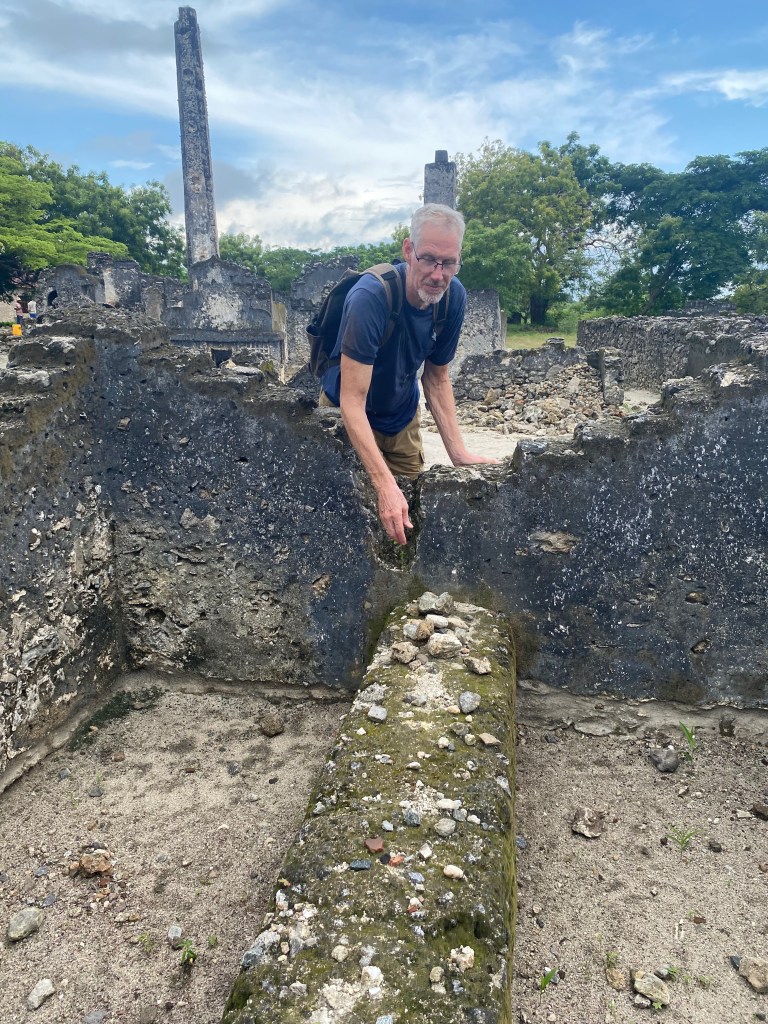
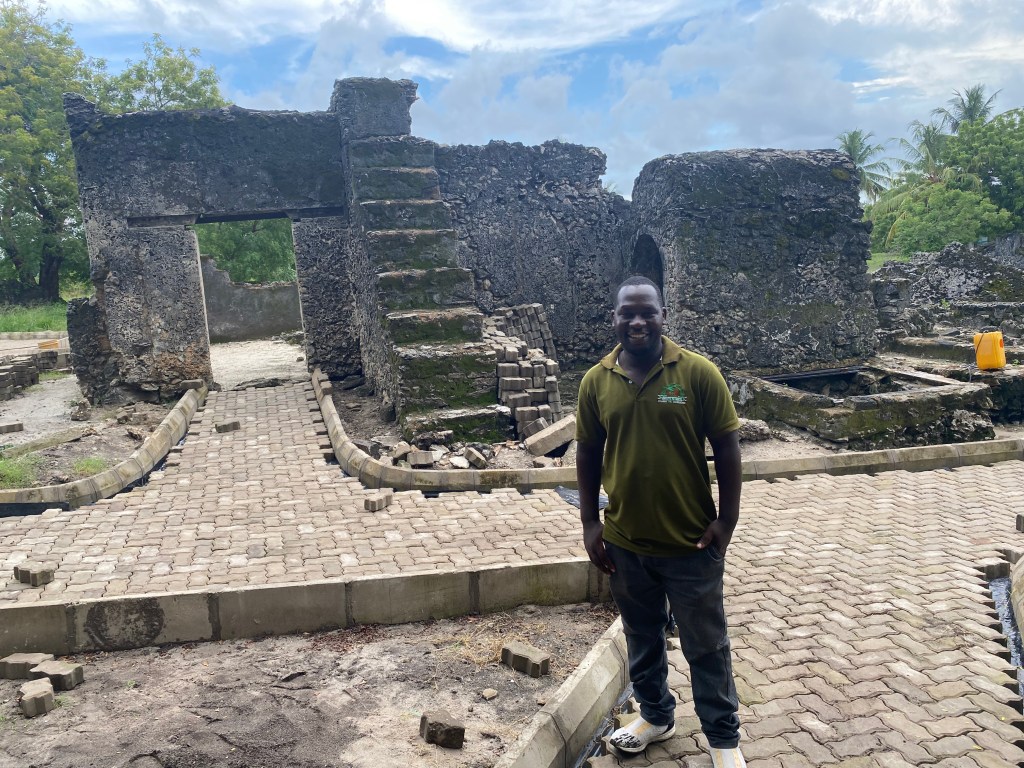
In the 8th century Muslim traders from Arabia and Egypt began to settle and trade in centers along the Swahili coast. Very close to Bagamoyo is an ancient site of one of the first permanent Arab settlements on the East African Coast – the Kaole Ruins. This includes the remains of a Mosque built in the 13th century and graves of prominent community members – the oldest such site in East Africa.
The site is a 15-minute ride on the back of a motorbike dodging potholes, chickens and children. The ruins are not spectacular although the building material – coral has a surprising stability. I had an enjoyable time with the guide – washing my feet and hands in holy water and praying to a couple of Profits – dropping 1,000 Shillings at each site, where the guide promptly took my offerings to the office – that’s why they call them profits.
The Slave Trade
Slaves from the interior of Africa were gathered at Bagamoyo port by native, Arab, and Portuguese traders for shipment on to Zanzibar, which, in the 1700s, began providing slave labor for local plantations, European colonies in Africa, and a small number of American plantations.
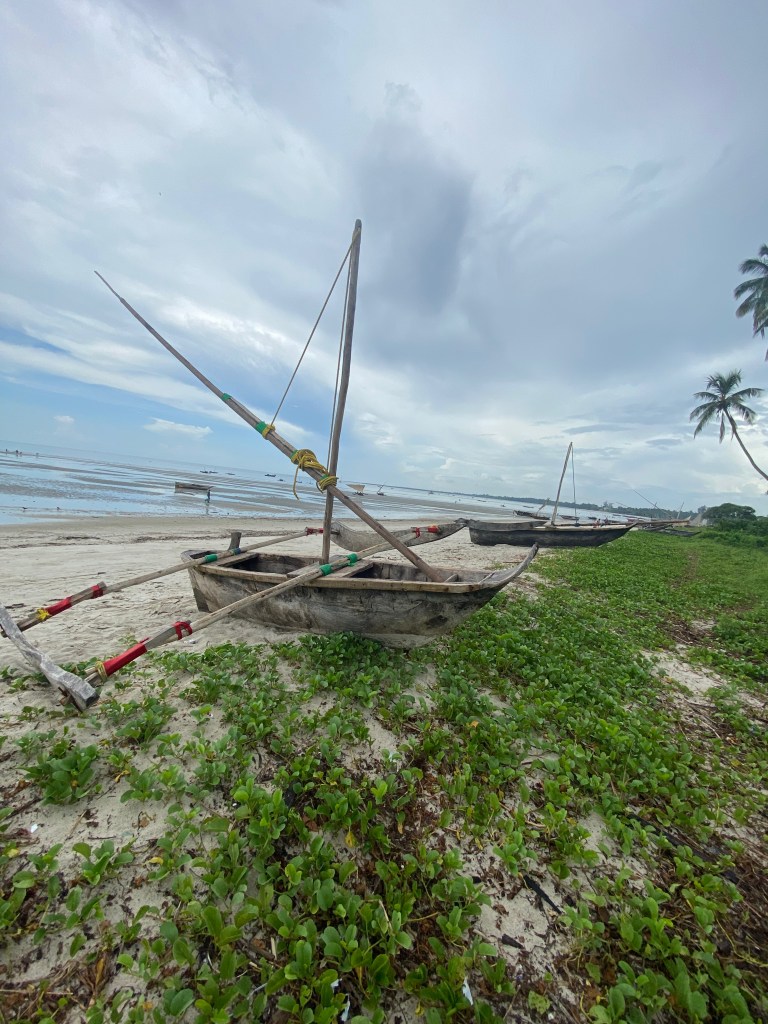
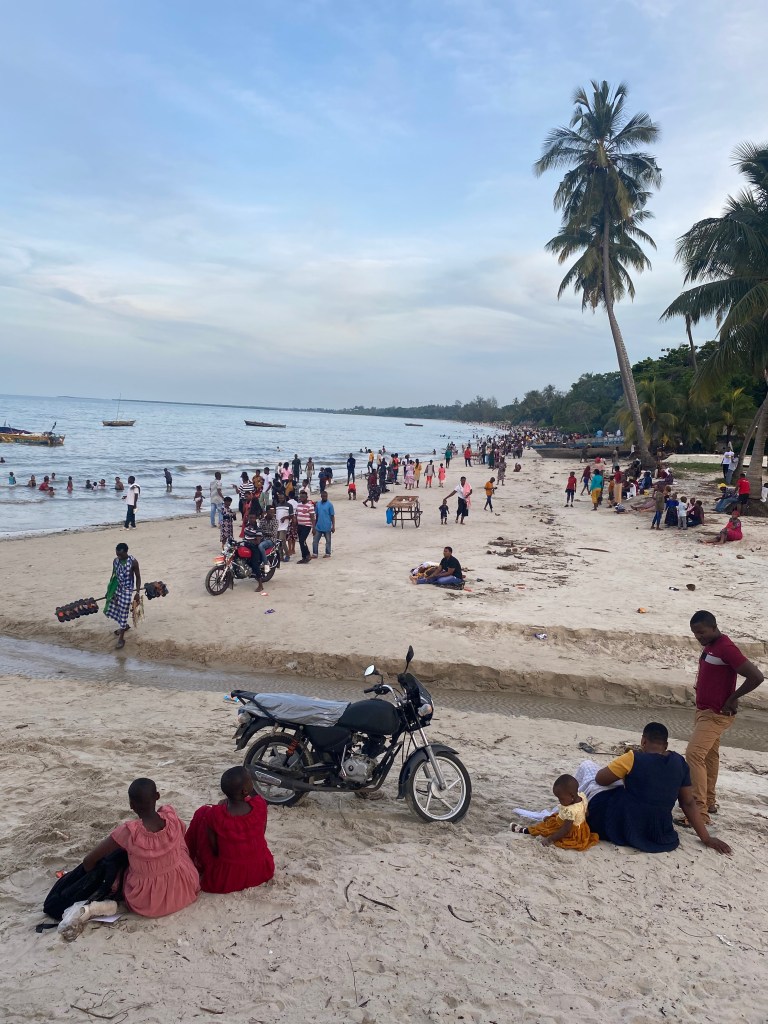
Bagamoyo for this slave route serves as the terminal which starts from Ujiji (where I was in December). From Bagamoyo, slaves were shipped to the island of Zanzibar (where I was in Oct 2023) and at the slave market men and women were sold and taken to destinations. One can see Zanzibar across the ocean from Bagamoyo. The port where slaves were put on dhows and sailed to Zanzibar is where the current Bagamoyo fish market is.
Unintentionally I have visited the axis points of one of the slave routes in Tanzania.
European Colonists
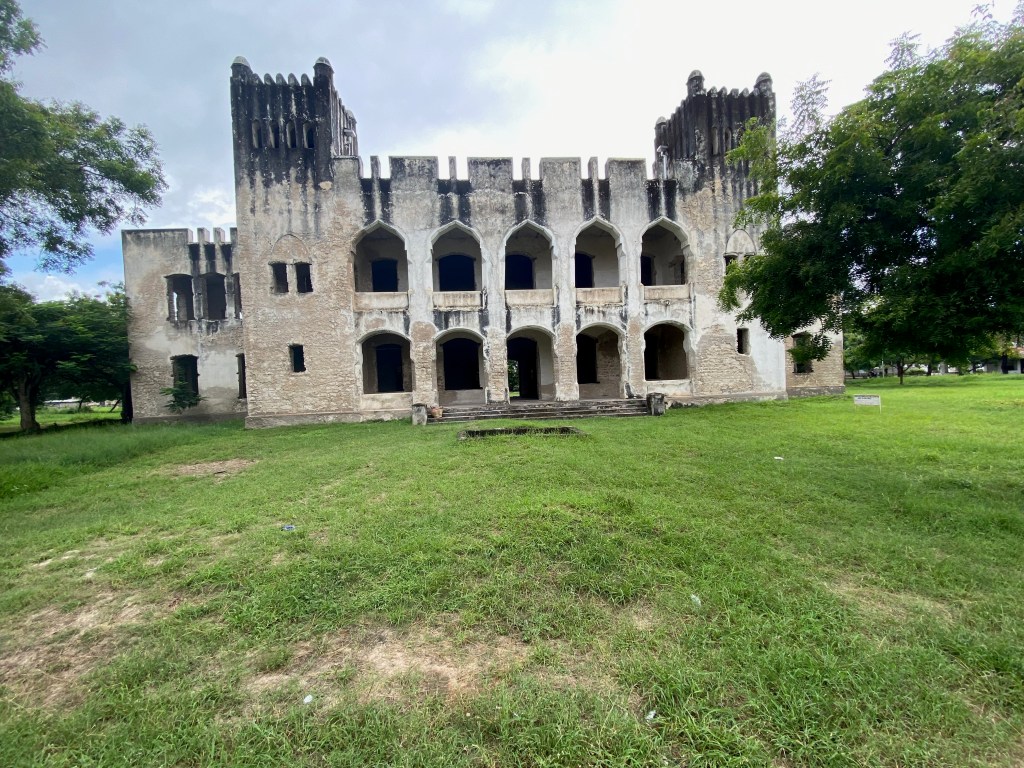
In the nineteenth-century the Germans arrived in Bagamoyo and left their imprint. Ostensibly they colonized East Africa in order to stop the slave trade but ended up profiting off it like all other colonists. They did a lot of building in Tanzania in a short time (1880 – 1918), including many buildings in Bagamoyo and they built a railway from the coast to the eastern side of Tanzania – Lake Tanganyika. The Brits took over after the First World War. Interestingly enough the Germans, like the Kaole Arabs, used coral as a building material. One can only guess how much ocean habitat was destroyed.
In 1822, the British signed the first of a series of treaties with Sultan Said of Zanzibar to curb this trade. Under strong British pressure, the slave trade was officially abolished in 1876, but slavery itself remained legal in Zanzibar until 1897. Slavery was only abolished in Tanganyika in 1922, so there are many monuments and memories remaining in Bagamoyo concerning the slave trade. Tanganyika and Zanzibar were separate countries but united on 26th April 1964, forming the United Republic of Tanzania.
Being White in Black Culture
Waves of dominant cultures have levelled abuses and injustices on these peoples. Yet Tanzanians are a proud peaceful people, focused on developing their country and raising the standard of living for all. Fortunately, the country is devoid of tribalism and the influence of extremist factions.
There is nothing overt, or blatantly racist I experience, yet my skin colour and my height draw a lot of attention, and not all of it is positive. Indirectly, I encounter a lot nonverbal or obvious resentment. I am a mzungu. There are different connotations of this. How I hear being referred to as mzungu and how I interpret is different in different situations. At the basic level, a mzungu is a white person. But there is a lot of baggage from centuries of abuse at the hands of white people and white people are most often associated with wealth and power. There is also strange kind of respect, admiration and status associated with mzungus. Example – leaving Bagamoyo I was shuffled onto one of two busses going the same place because there is status having a mzungu riding on your bus.
Mostly I just accept the commonness of being called mzungu but often times I hear some of the baggage behind the “cat call.” It usually happens as I walk past a group of men who look at me with resentful eyes and then I hear discussion as I walk past as they refer to the mzungu and laugh.
“Mzungu” is simply a factual acknowledgement that here is a “white person” for most, but for some it is everything a white person represents for the person saying it. And what is represented are the layers of history.





Previous Posts
Oct. 2023 https://twoacres.blog/2023/11/02/a-month-in-morogoro-tanzania/
Nov. 2023 https://twoacres.blog/2023/11/24/learning-to-wait/
Dec. 2023 https://twoacres.blog/2023/12/29/genetic-brothers-and-sisters/
Jan. 2024 https://twoacres.blog/2024/01/22/being-ki-rafiki-friendly-and-other-stuff/
 Kilimanjaro Dreams