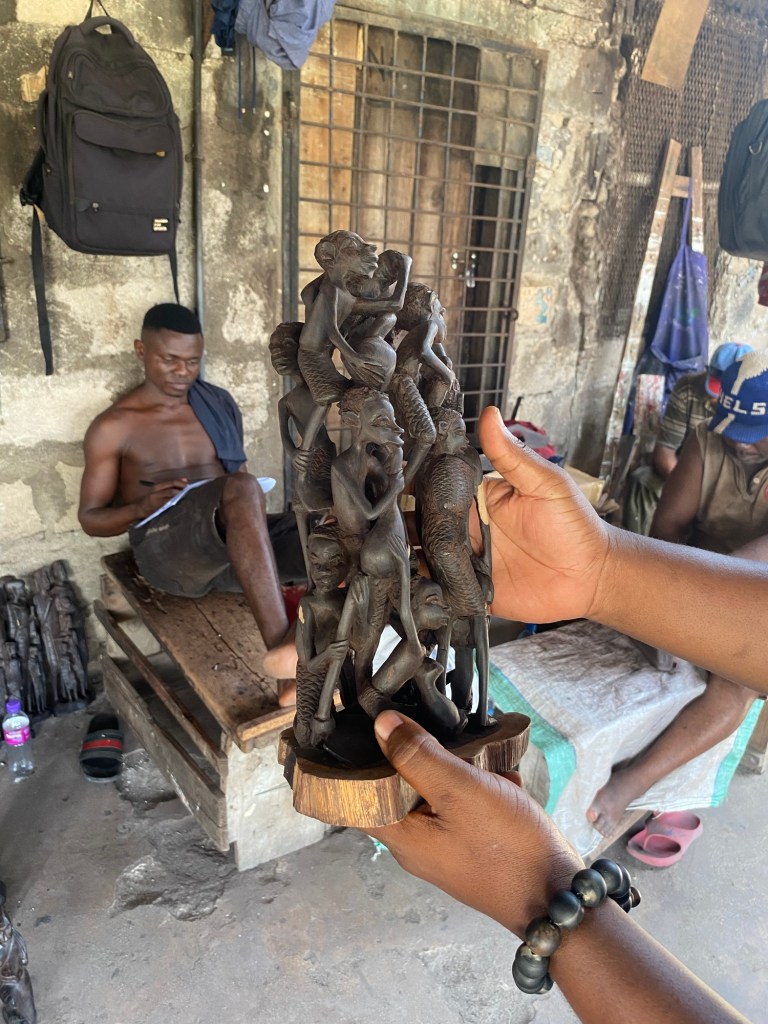
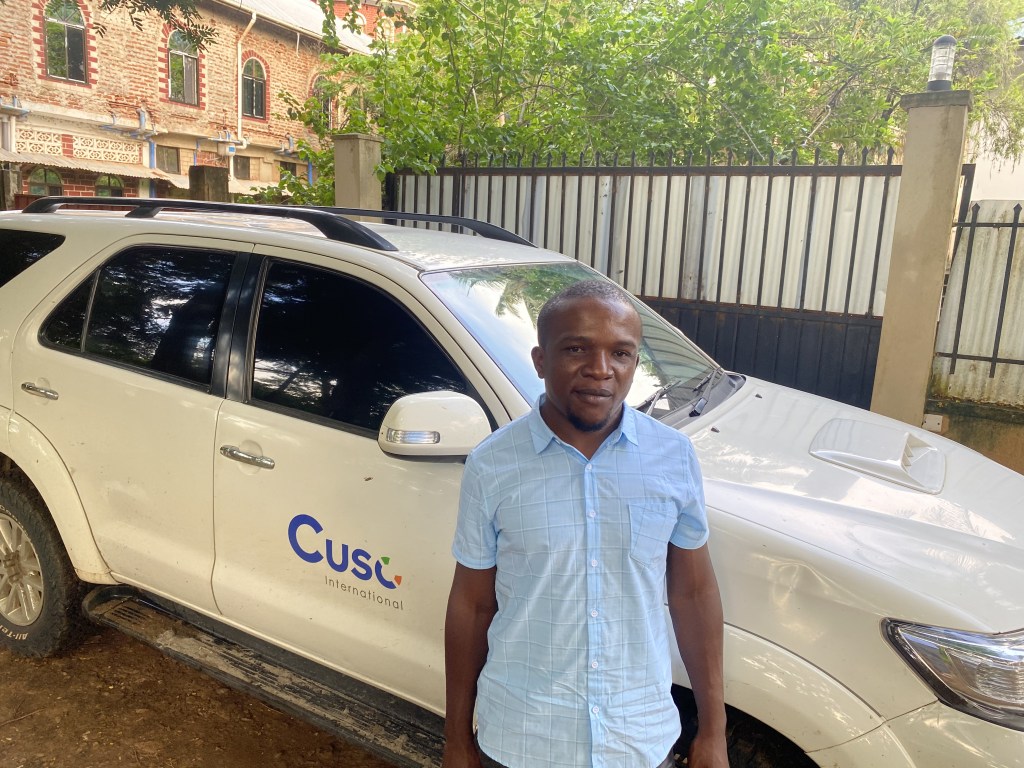
Arusha

There are many attractions in the city of Arusha and the northern regions of Tanzania. With my time running out it was time to visit. 

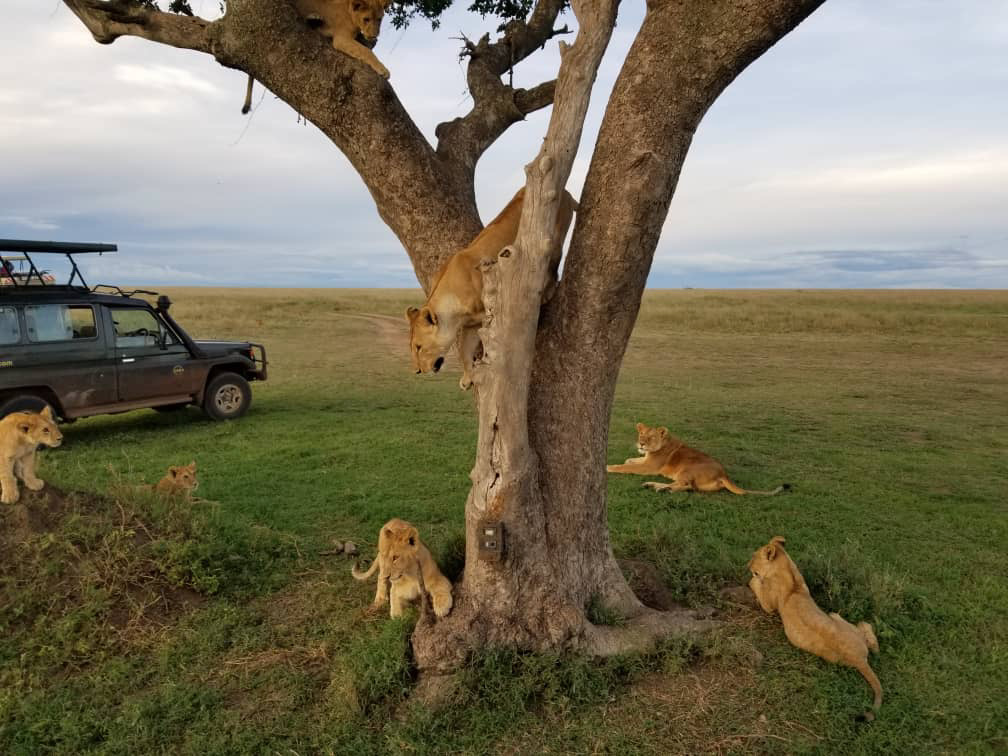
Sites to see include Mount Kilimanjaro, Serengeti Plains, Ngorogoro crater, Olduvai gorge (where the first hominoids were discovered) as well as many other national parks with flora and fauna not seen elsewhere. As well this is the home region of the Maasai tribe who mostly live a traditional village life grazing cattle. 

It would be easy to spend a lot of time and money exploring the region, both of which I do not have. I took a 10-hour night bus from Morogoro to Arusha, spent 4 days seeing things and then returned on a 10-hour night bus back home. 

I did not have a plan nor did I really narrow down what I wanted to see. I am pathetic making decisions on what to do via internet research. Everything looks amazing in pictures and the prices for doing any of these things seem insane. 

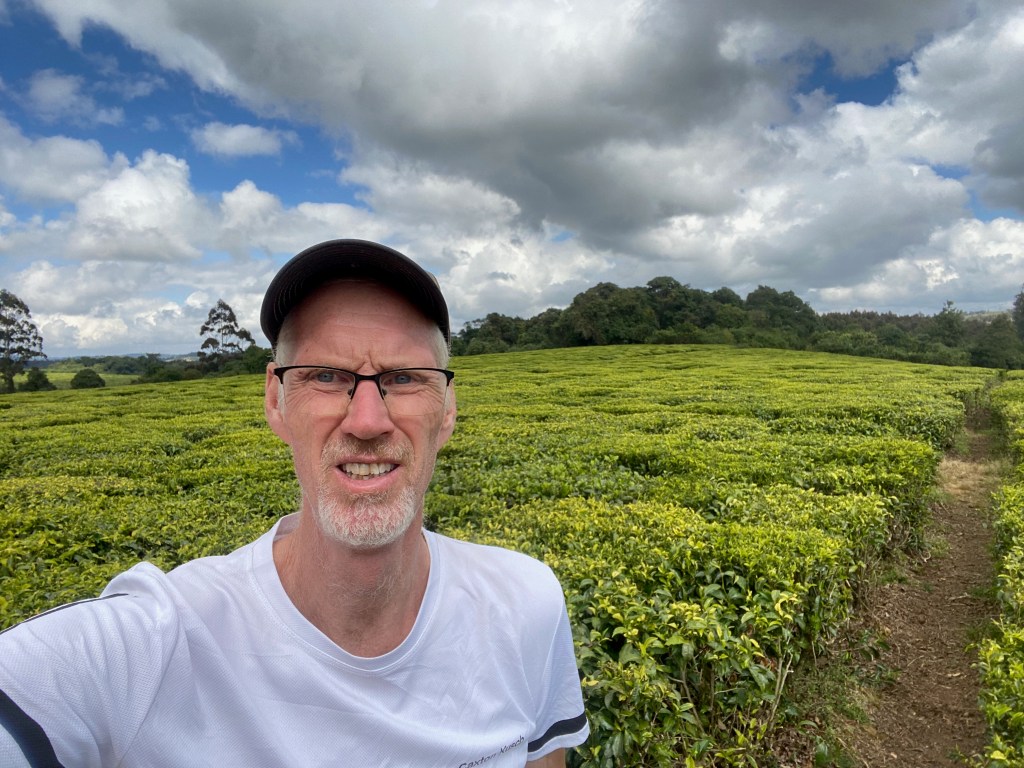
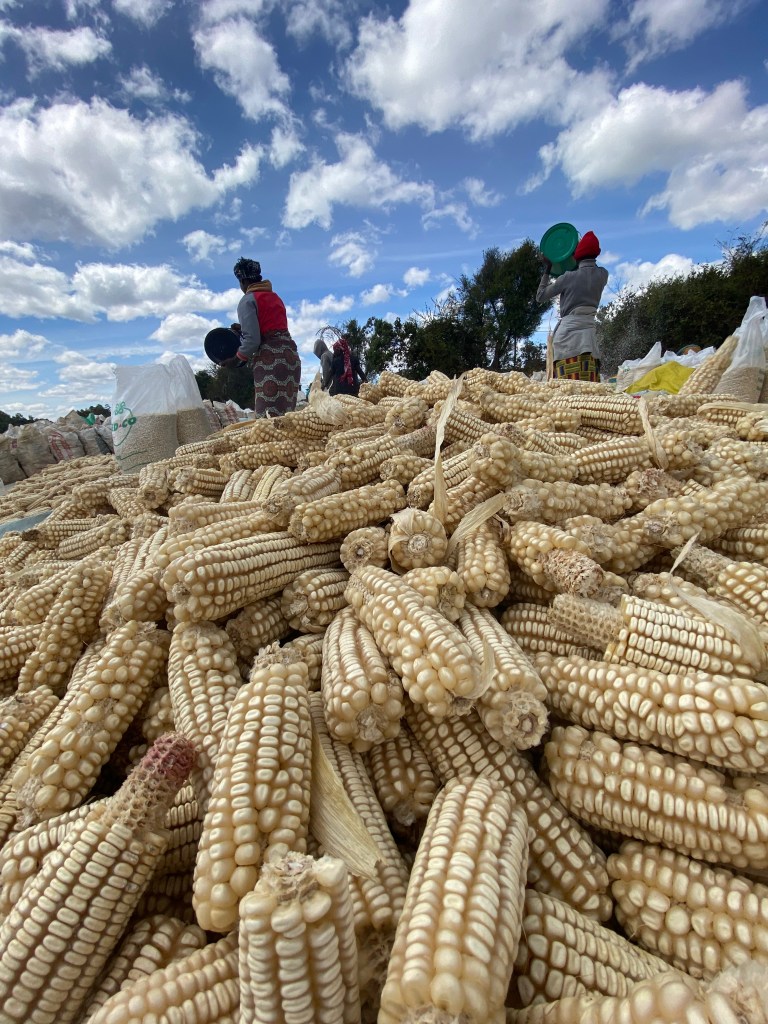
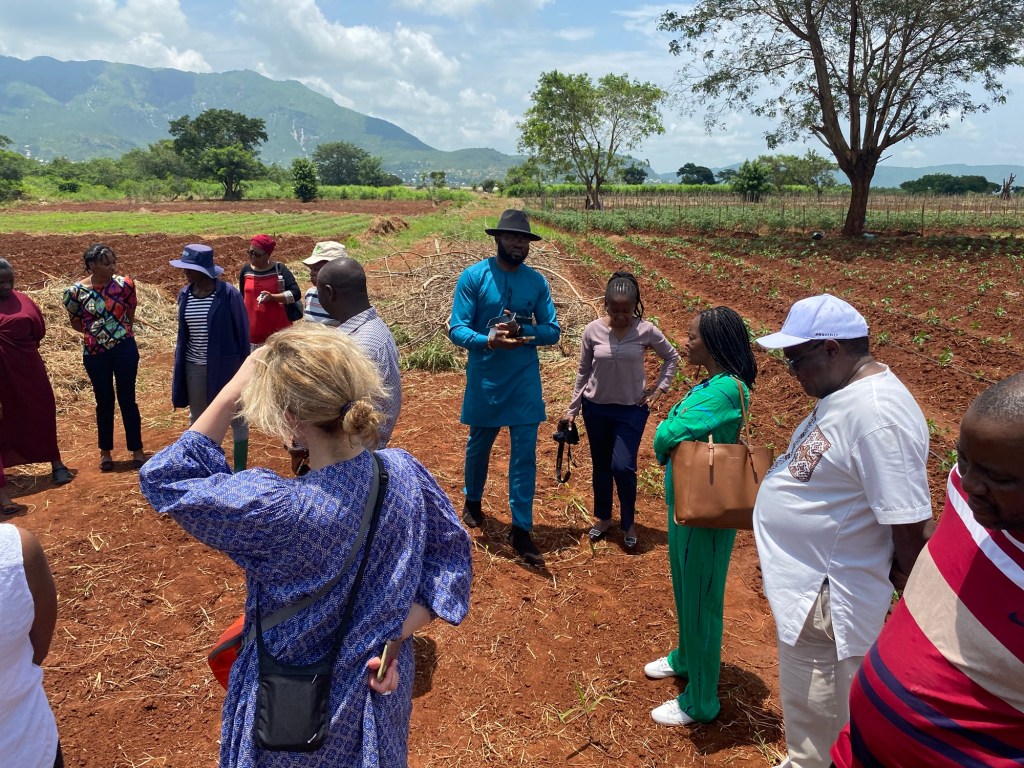
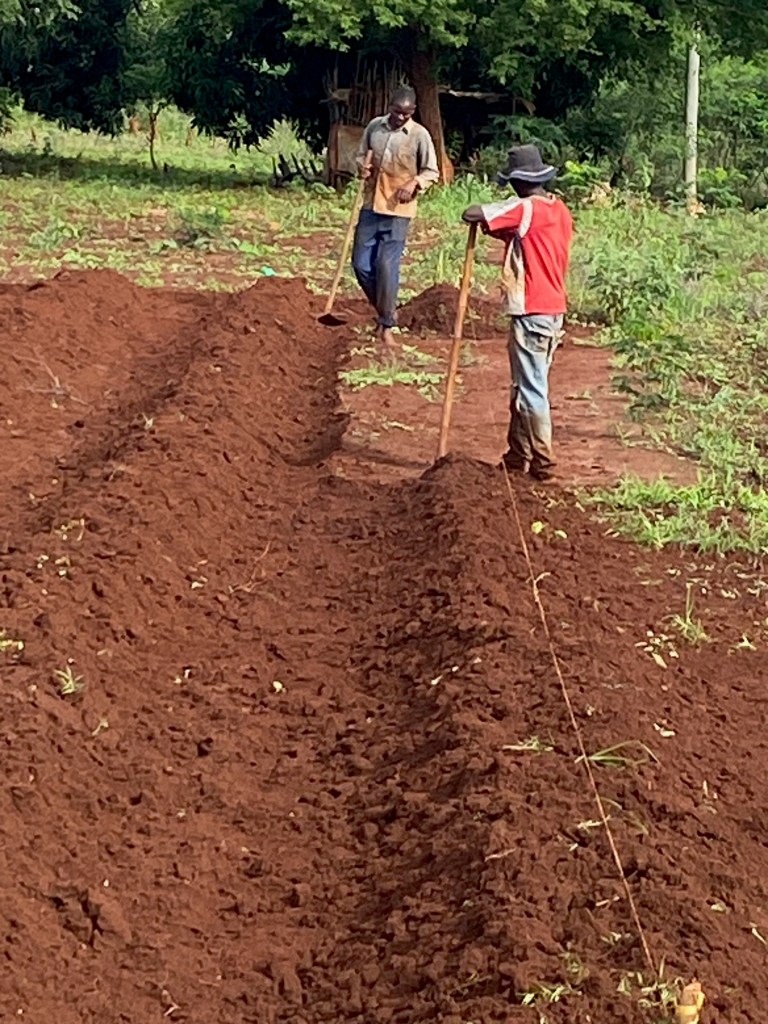
Many of the people I work with are from the Chagga tribe who originally resided on the slopes of Mount Kilimanjaro, the wealthiest tribe in Tanzania who got that way from the growing crops in rich volcanic soils around the mountain. The agricultural aspect intrigued me. 
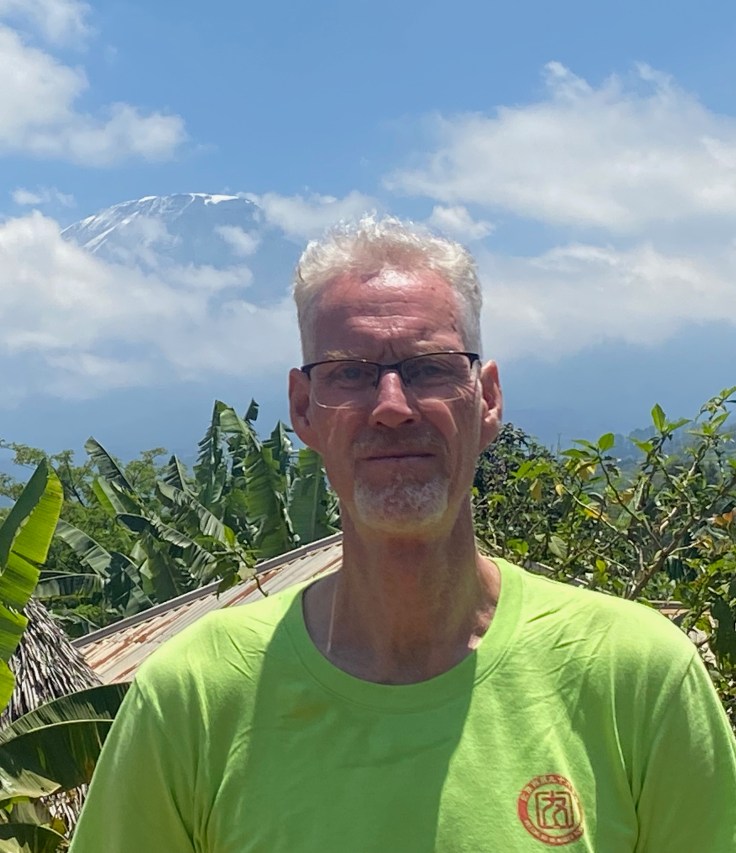
Kilimanjaro behind

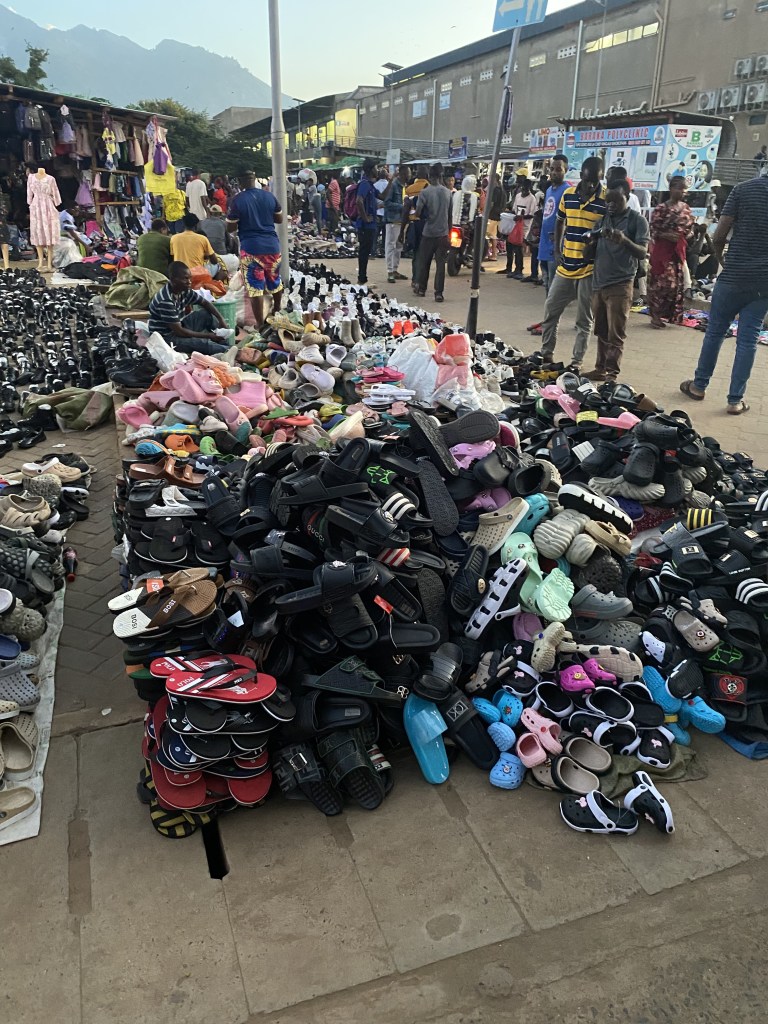
I took a daladala to Moshi from Arusha. Daladala are local buses that never refuse a passenger, stuffing people on top of each other and they stop everywhere to pick and drop off passengers. I have never seen other muzungos take these buses, but these contact sport transport options are where the life is. Daladala don’t run on a schedule, instead they wait at the bus stand until there is absolutely no more room to fit anybody on the bus and then they depart. While waiting, vendors outside yell selling food, drinks, cell phone chargers, shoes, jewelry and more to suffering passengers. Somehow it all works, albeit uncomfortably so.

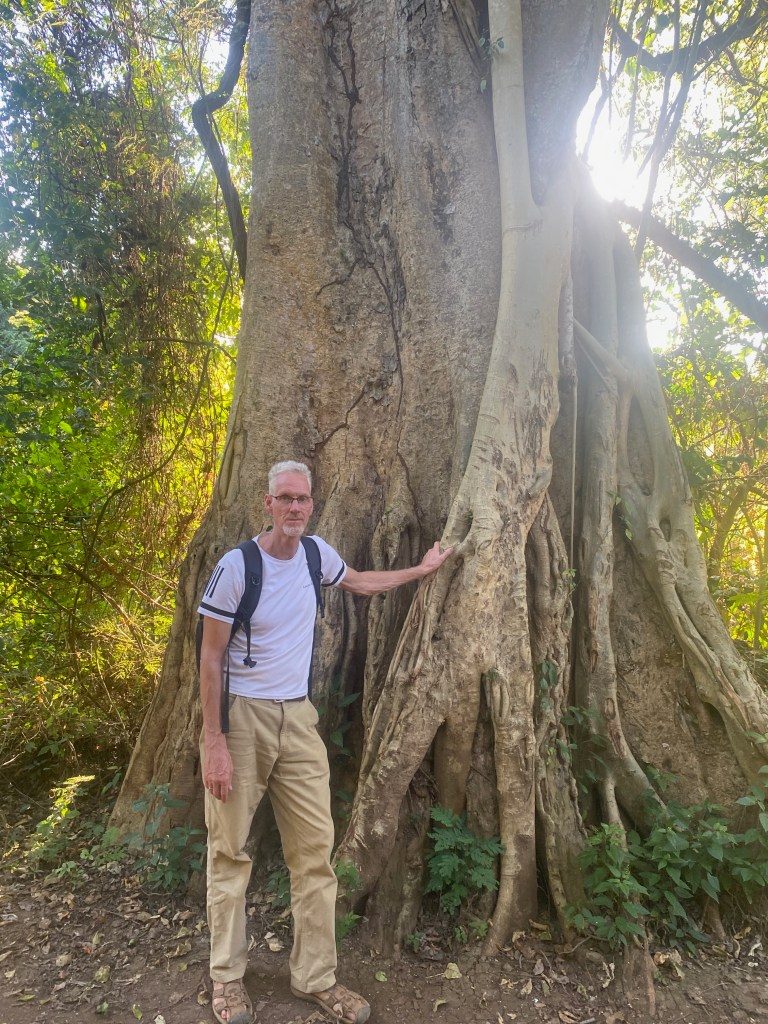
Moshi is a town on the foot of the volcano where I took a hike in a forest on the edge of town with some giant trees hosting Black and White Colobus and Blue monkeys (Rau Forest Reserve) and later rode on the back of a bodaboda (a motorcycle) up the side of the volcano to an organic coffee plantation. 
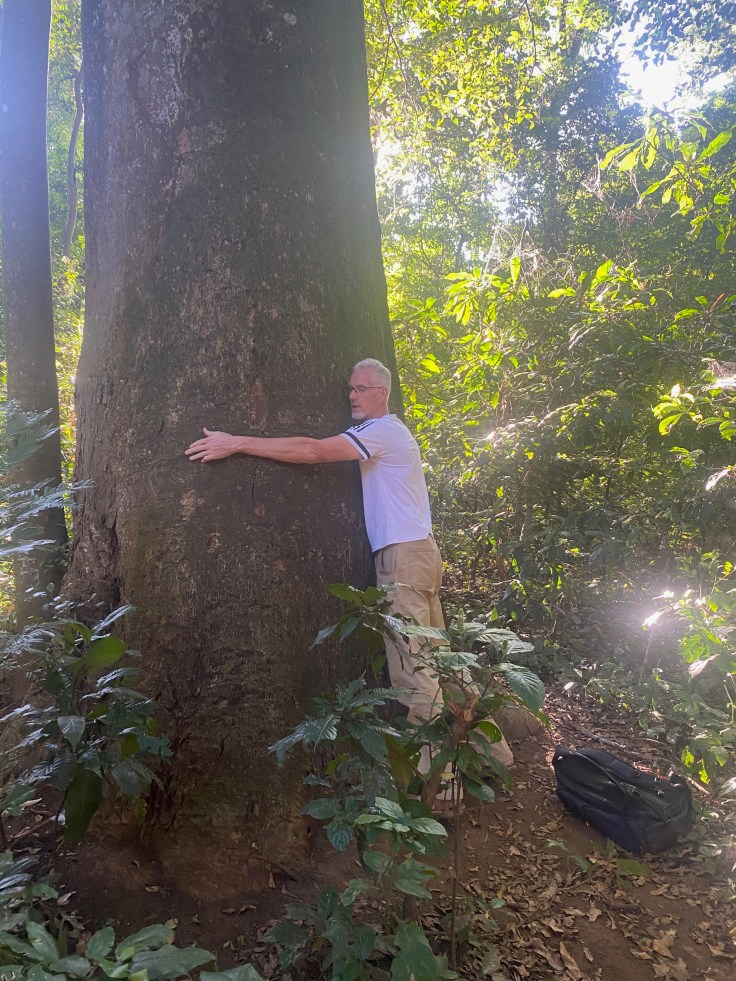
Still a tree hugger

There were no signs at the plantation so we drove up and down the mountain asking villagers for the location. Coffee grows best in the shade and here the coffee is grown under banana plants amongst taro root and random avocado and mango trees.  Removing husk, winnowing, grinding and roasting were all done with manual devices.  I had a nice cup of coffee made from fresh beans after I watched the processing and men dancing as they worked.
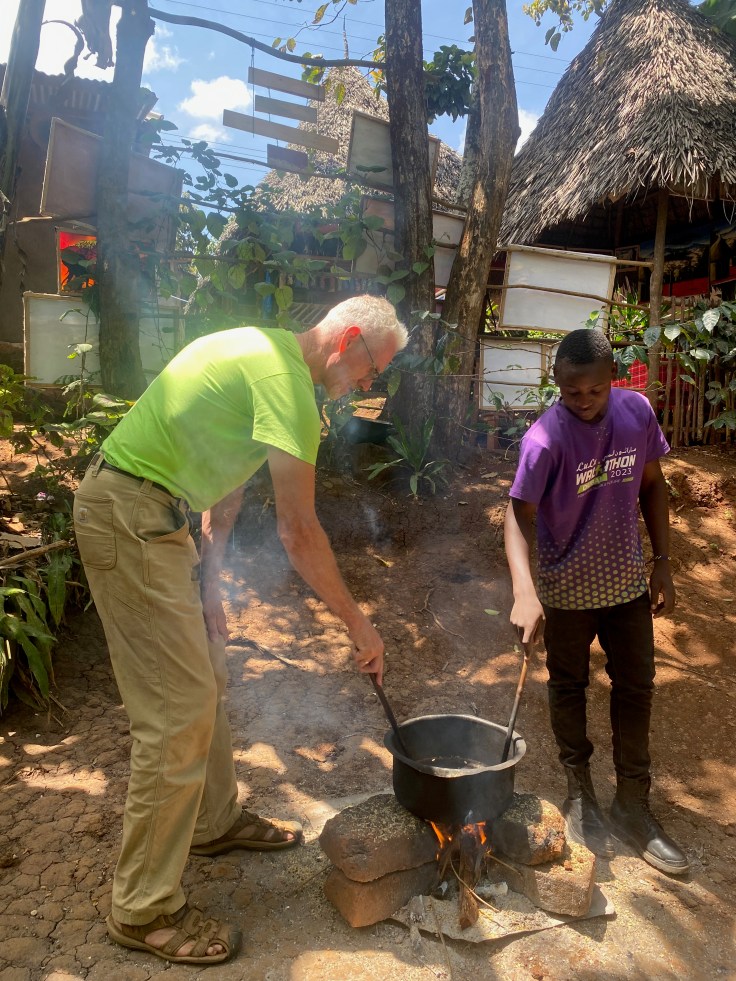
Roasting beans

In Arusha I visited the natural history museum and learned about Tanzanite, a blue/green/ruby gem stone. The only place in the world it is found is in a mountain fold near Arusha. The Maasai used this stone in a rudimentary board game for centuries until in the 1960’s somebody had the mineral analyzed and found out it was a blue zoisite (very rare).  Tiffanies named it Tanzanite and wanted lots of it. It is no longer used in board games. For Tanzanians, this is an engagement gem.

Tanzanite

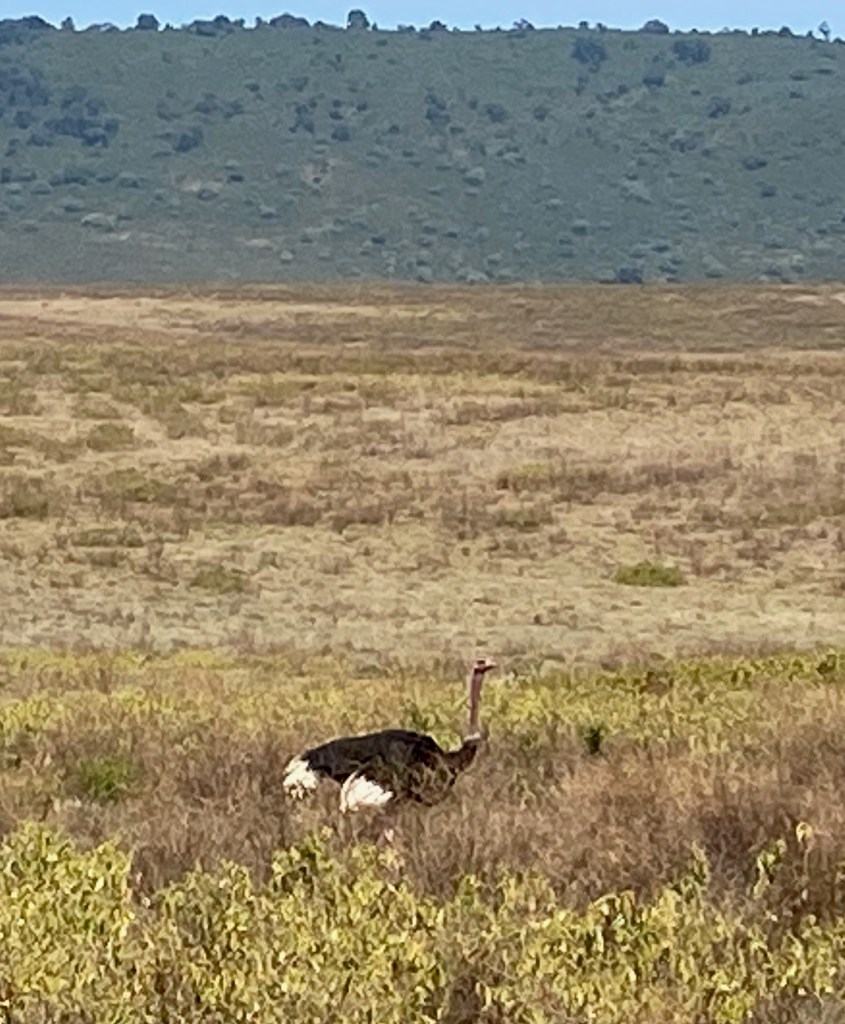
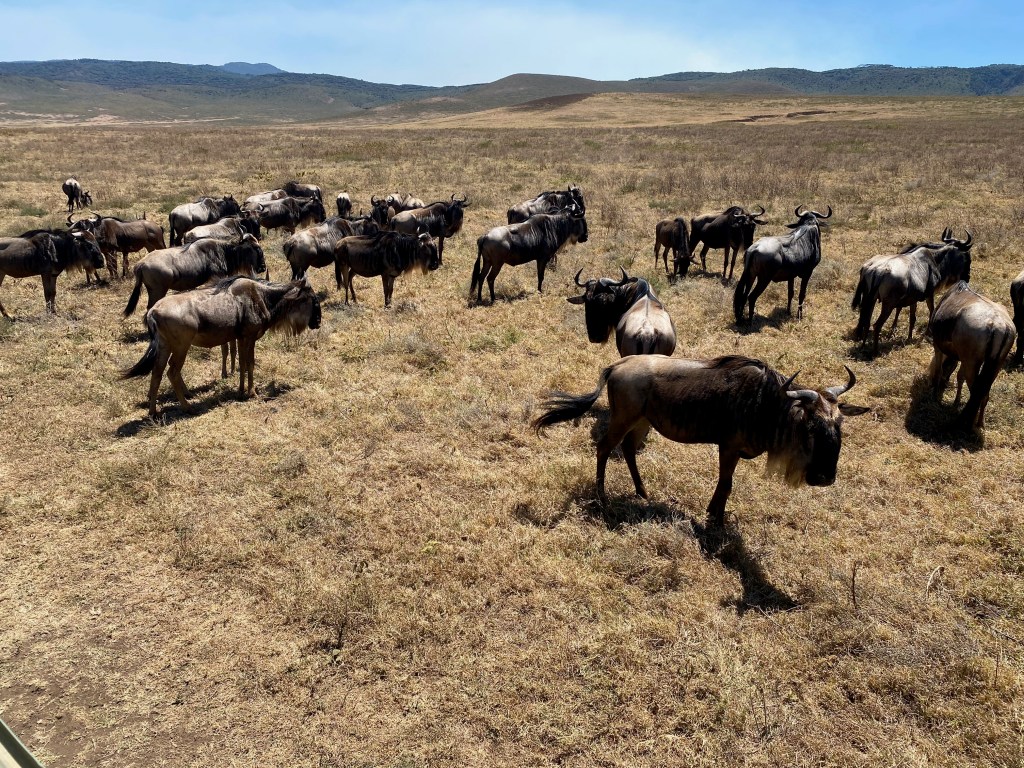
The one big financial plunge I took was to take a one-day safari to Ngorogoro Crater. This is the biggest intact (unbroken) volcanic caldera on Earth. A caldera is a large depression formed when a volcano erupts and collapses. The Ngorongoro Crater is also a natural sanctuary for some of the densest populations of large mammals in Africa and contains the big five ((elephant, lion, leopard, buffalo, rhino). 

Due to its enclosed nature, the Ngorongoro Crater is its own ecosystem. Livestock belonging to Maasai tribe graze alongside wild animals – and Maasai are allowed to kill lions stocking their herds. Killing a lion traditionally was a rite of passage for young Maasai men but this practice is minimized due to declining lion populations. 
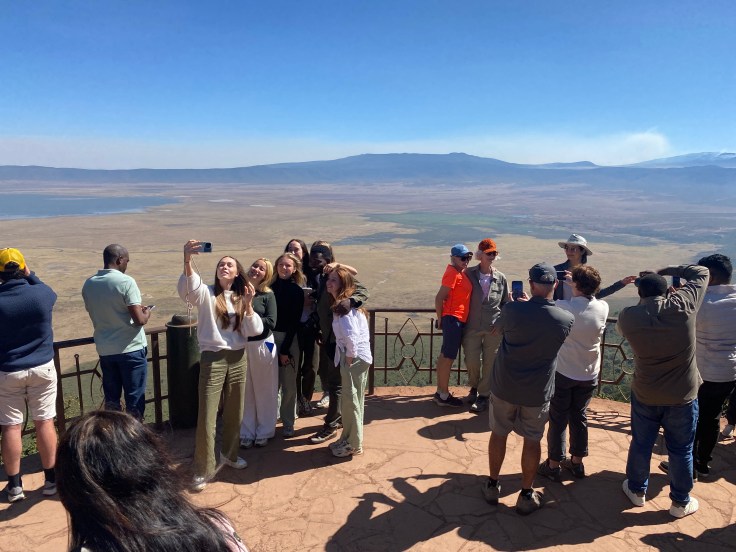
Ngorogor Crater

Safaris are big business in Tanzania and especially in Arusha. For a year I have been negotiating prices for everything from the price of a mango to the cost of a bodaboda ride. I feel proud when I save the equivalent of 25 cents. On principal I want to spend the same amount as a Tanzanian. But for Ngorogoro Crater, you have to pay Mzungu prices. So, I bit the bullet. 

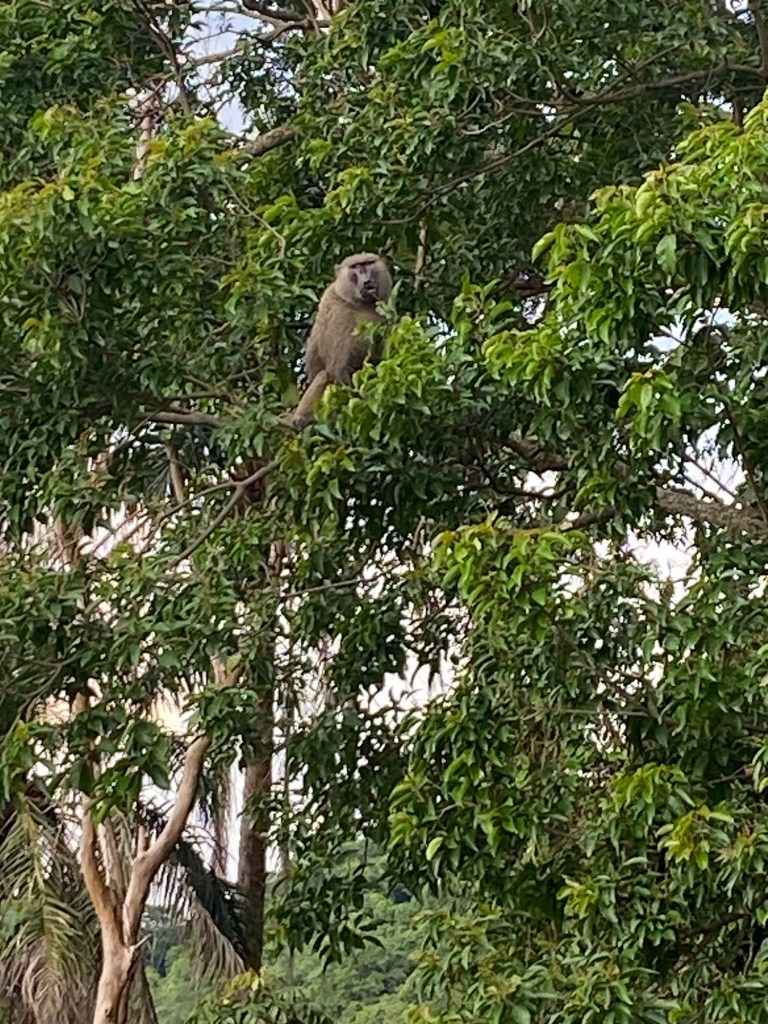
This is high season for safaris because it’s the dry season. Along with roughly 200 other safari vehicles, each filled with 4 – 10 tourists, we drove the circuit inside the crater. I shared the vehicle with 3 Brits and an American. We saw elephants, wildebeest, water buffalo, lions, hippos, baboons, zebras, warthogs, ostrich, several verities of antelope and gazelle. I enjoyed this very much. 

I am finishing tasks in my last 10 days in Morogoro. I have many feelings about this.
Previous Posts 

Oct. 2023 https://twoacres.blog/2023/11/02/a-month-in-morogoro-tanzania/  

Nov. 2023 https://twoacres.blog/2023/11/24/learning-to-wait/  

Dec. 2023 https://twoacres.blog/2023/12/29/genetic-brothers-and-sisters/  

Jan. 2024 https://twoacres.blog/2024/01/22/being-ki-rafiki-friendly-and-other-stuff/  

Feb 2024  https://twoacres.blog/2024/02/26/ah-to-be-young/  

April  2024  https://twoacres.blog/2024/04/14/meandering-mzungu/  

May 2024 https://twoacres.blog/2024/04/30/direct-aid/  

June 2024 https://twoacres.blog/2024/06/12/remember-the-future/     

June 2024  https://twoacres.blog/2024/06/21/mobile-money/ 

July 2024. https://twoacres.blog/2024/07/18/gansta-rap-and-the-goat/

August 2024.  https://twoacres.blog/2024/08/27/tribal-tendency/

August 2024.   https://twoacres.blog/2024/09/17/arusha/

Tribal Tendency

What happens when we meet someone for the first time?

I meet a lot of people these days and I see myself putting this new person through filters, fishing to see if there is some commonality. Where from? What are you into?  Do you like Trump?  Are you Liberal?  Do you eat meat? Do you think climate change is real? Friend? Foe?

I just started reading a book called “Our Tribal Future,” after hearing an interview with the author – David R. Samson. It’s about human evolution and how we evolved living in tribes. And how much of the tribe drive is very evident in modern societies; not surprising since 99.9% of our evolution was living as members of tribes. 

For me this book helps me reflect on how evolutionary tendencies that drive my behavior, exposing the unconsoius choices about who I associate with and who I am repelled by. It asks questions to help me reflect on my unconscious biases – so I can make conscious choices. 

He talks about the signals we give to inform others of who we want to associate with. In the pre modern world, tribes provided very obvious signals and symbols to communicate who was safe to associate with, who has the same world view and who was not one of “us”

Two Maasai. Me holding a Maasai rungu which all men carry. For warfare and hunting.

Traditional Maasai in Tanzania still retain their symbolic association through clothing. The tribe is still very strong. Originally nomadic, they are now a pastoralist society with settlements. A traditional Maasai lifestyle concentrates on grazing cattle. I see Maasai grazing cattle along the highway and Maasai men wandering through villages and cities selling leather goods.  The measure of a Maasai man’s wealth is in terms of children and cattle – the more the better. I met the guys above at a rice growing trial where several varieties were being tested. Their herd of cows were grazing on the road side.

I work with many Chagga people. The Chagga are a tribe from the north part of Tanzania around Mount Kilimanjaro. Because of their access to Mount Kilimanjaro’s fertile volcanic soils the Chagga became the richest of all Tanzania’s tribes. Although they grow beans, bananas and maize – their Arabica coffee brings in most of the tribe’s earnings. They are the most educated tribe in Tanzania. Chagga are Tanzania’s business people and their reputation is their desire  to make money. 

A Chagga friend recently accepted a job with the Tanzanian government as an agricultural extension officer. The job is located in the very southern part of Tanzania, about 30 hours bus trip from Mount Kilimanjaro. She was very concerned about being so far away from her people, but when she met her boss she found out he is Chgga and that her immediate supervisor is also Chagga. Instantaneously she felt supported and protected and knew she be taken care of for any needs she may have. This I find very appealing – to know that complete strangers can be instant friends.

This bond is felt amongst all tribes. When I ask young people I work with how they feel about fellow tribe members, their faces change and talk about instant connection. Even today, tribe members are brothers and sisters. 

This powerful force holds people together with support and is missing in western developed cultures where individualism dominates ethics and values. Our drive towards individualism separates us and isolates us. It seems we are all seek belonging, needing commonality and shared values.. An expression of this is the MAGA movement.

I suppose we all have different tribes, various concentric circles of people close and far away that we associate ourselves with and feel bonded to. I find it fascinating how human evolution, the 99.9% of the history of our species we spent with family groups, bands and tribes expresses itself in modern behaviour. 

Previous Posts 

Oct. 2023 https://twoacres.blog/2023/11/02/a-month-in-morogoro-tanzania/  
Nov. 2023 https://twoacres.blog/2023/11/24/learning-to-wait/  

Dec. 2023 https://twoacres.blog/2023/12/29/genetic-brothers-and-sisters/  

Jan. 2024 https://twoacres.blog/2024/01/22/being-ki-rafiki-friendly-and-other-stuff/  

Feb 2024  https://twoacres.blog/2024/02/26/ah-to-be-young/  

April  2024  https://twoacres.blog/2024/04/14/meandering-mzungu/  

May 2024 https://twoacres.blog/2024/04/30/direct-aid/  

June 2024 https://twoacres.blog/2024/06/12/remember-the-future/     

June 2024  https://twoacres.blog/2024/06/21/mobile-money/ 

July 2024. https://twoacres.blog/2024/07/18/gansta-rap-and-the-goat/

August 2024.  https://twoacres.blog/2024/08/27/tribal-tendency/

Gansta Rap and the Goat

Eating has been a challenge for me. I very rarely feel like I have satisfied my palate. 

For many months I could not figure out what was safe to eat. Early on I had several bouts of traveler’s diarrhea/food poisoning but now I think my gut bacteria has changed somewhat. Yet it is always an act of faith eating because getting sick from food is normal, even for Tanzanians. The other day a Tanzanian friend got typhoid, most likely from salad washed in tap water. 

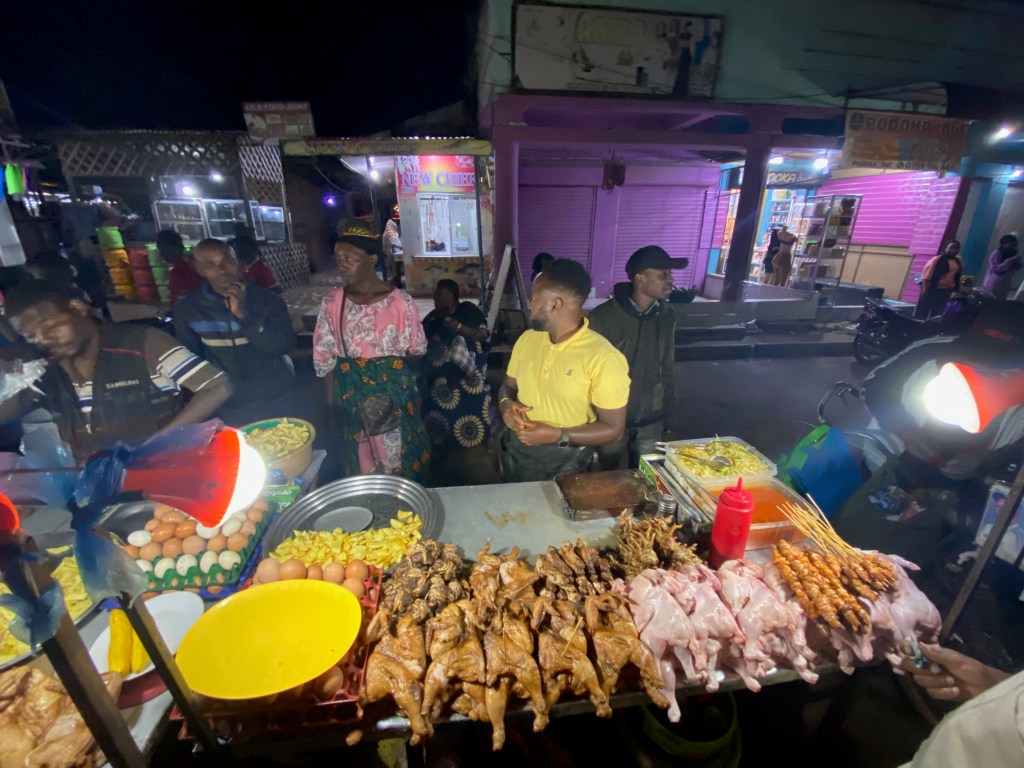
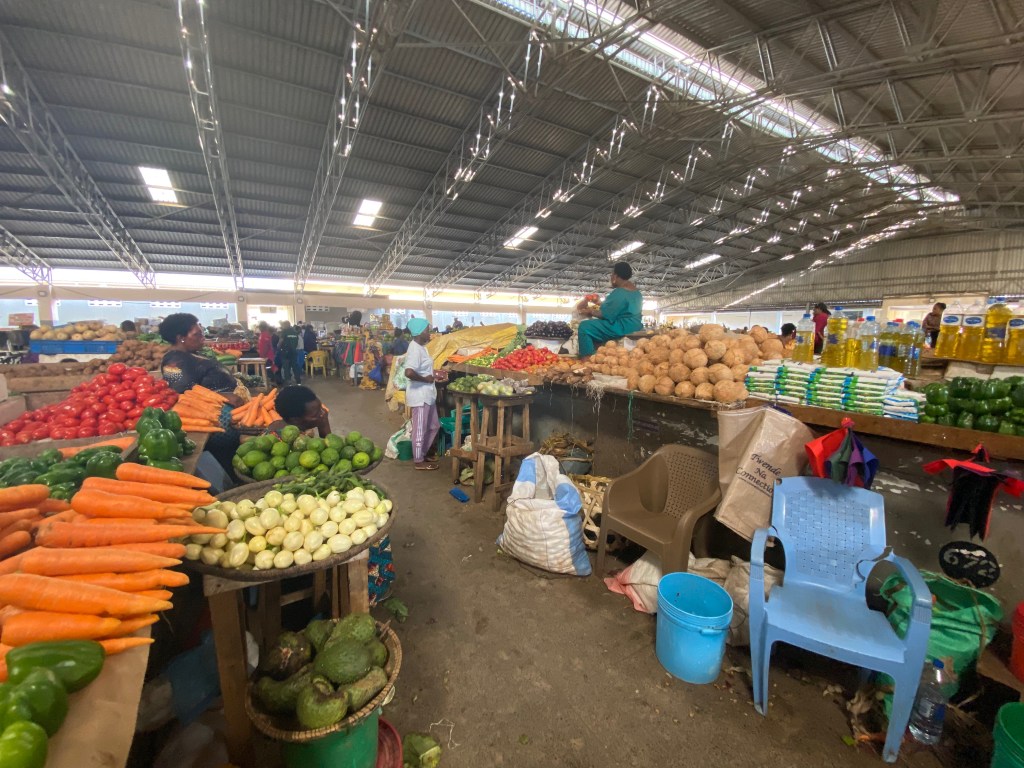
Food is everywhere. Fruit and veggies are sold in road side booths and every night women put down tarps and sell what they are growing. In Morogoro, there is a huge permanent market where all kinds of food is sold. For reasons I cannot explain to you or myself, I have not figured out my food situation. I haven’t gotten into cooking and can never figure out what to cook. 

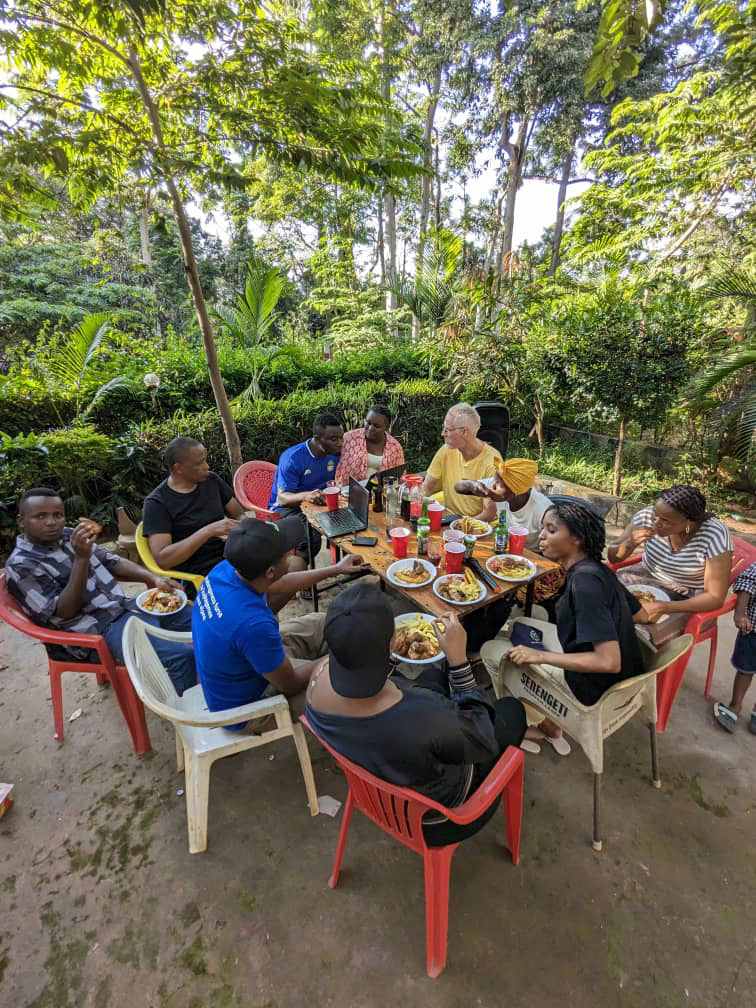
Recently I was a BBQ party. Several weeks prior to the event, the organizer created a whatsapp group for invitees. Deciding on the menu took many days of texting, more importantly how much money they were willing to spend.  At the core of the discussion was the cost of the goat to be slaughtered. Everyone knew somebody who knew somebody who had a goat. Eventually an appropriately priced goat was chosen. 

The party started mid-afternoon and preparing the food together started before I arrived. Initially they wouldn’t let the mzungu (white man) do anything so I wandered around watching. 

In the corner of the large compound were several guys butchering the goat – men’s work.  They were chopping it into pieces with a machete on a rusted piece of corrugated metal. Flies and ants were very excited.

The goat

There was a pervasive odour of blood and shit. One of the guys was cleaning out goat intestines with a garden hose and a bucket. Together they were laughing, chopping and squeezing shit out of rubbery intestines. 

Meanwhile, in another area the women were chopping vegetables. Nobody uses a cutting board, instead vegetables are cut by holding the veggie in one hand slicing it against the palm. One of the women handed me a potato to cut into chips (French fries) and the women all laughed as I struggled to cut using her instructions – of course I was used to cutting on a board. 

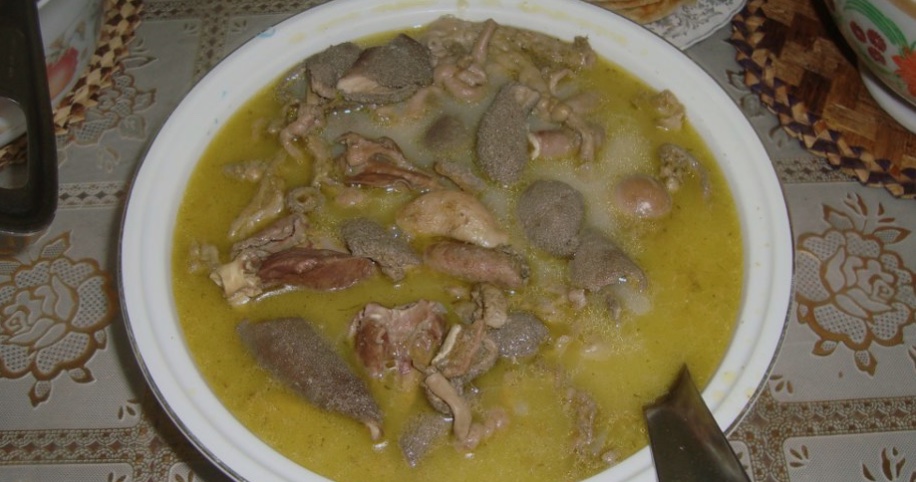
Eventually, the first dish was ready – utumbo – intestine soup. Without knowing, I was the guest of honor – mzungu – and was handed the first bowl of soup, clear goat broth with those same beige intestines I saw recently. They all watched as I took my first sip feigning appreciation and praises to the cook. When eyes were off me, I handed the bowl to my friend and quicky took a good slug of beer. 

Tanzanians love meat. Meat is cooked everywhere and men claim if you don’t eat meat, you are not a man. I regularly go to a cafeteria near the farm where I can get chips mayai. This is French fries mixed with a couple of eggs, cooked on a grill in a small pan – a French fry omelet. One of the guys I go with reminds me that I am eating women’s food, with the caveat, “for you mzee (old) it is ok.”

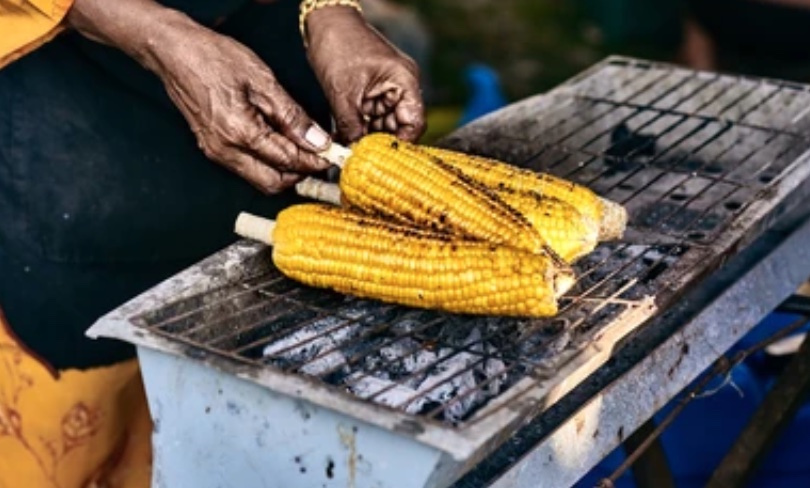
The go to fast food here is mishkaki and is cooked everywhere. Mishkaki is skewered chunks of beef, sometimes chicken, bbq’d on a grill. Everywhere there are booths with chipsi (French fries) cooked in large woks filled with sunflower oil along with small charcoal grills to cook mishkaki. Chipsi and mishkaki are always available – meat and potatoes.

Mishkaki

Most local food establishments do not have menus because there are only a few dishes available. The standard fair is grilled, deep fried or roasted meat, deep fried or boiled bananas, overcooked stewed vegetables, cooked beans and some kind of overcooked green. Most times there is also some kind of tomato sauce and pilli pilli (habearo pepper sauce) on the side. 

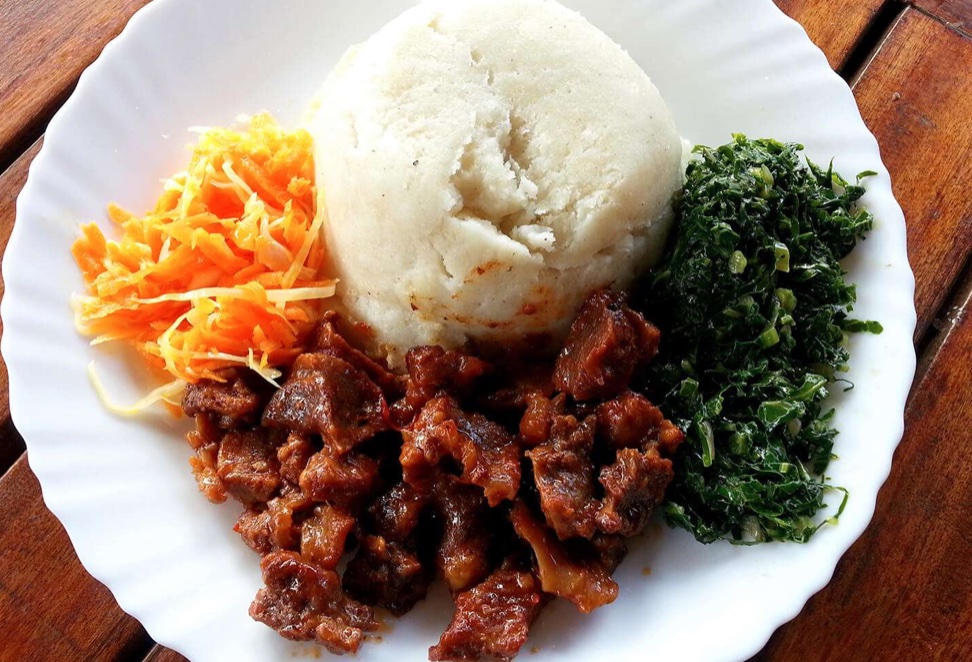
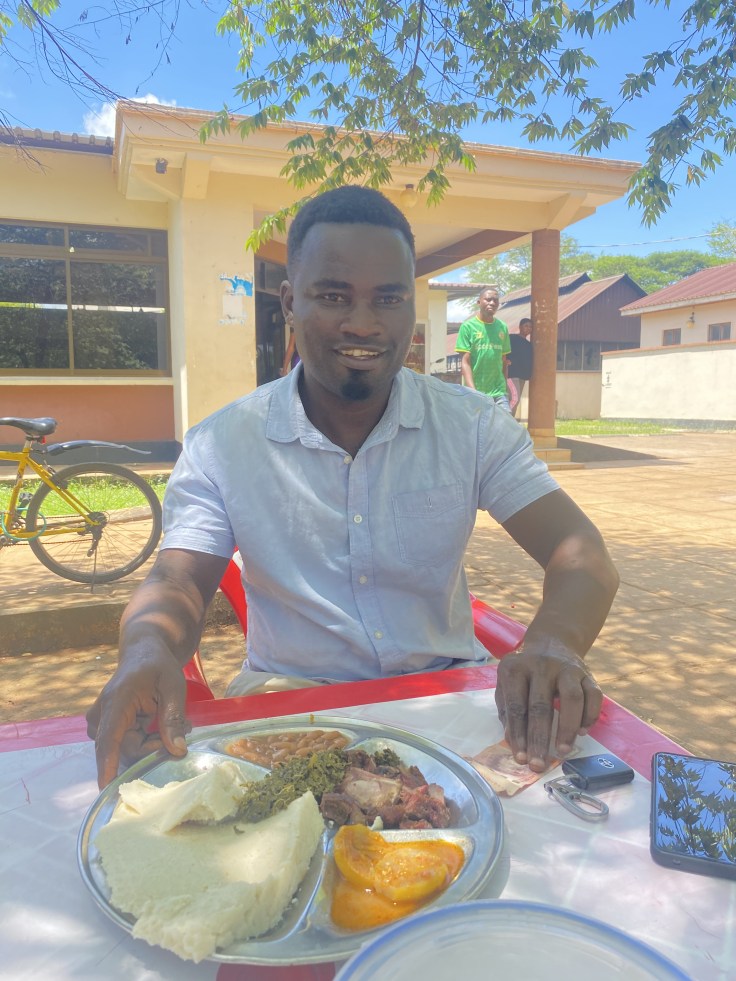
There is rice or ugali. Ugali is a stiff dough prepared with cornmeal, cassava flour, sorghum or millet. Most ugali in Tanzania is cornmeal based but in other East Africa countries and West Africa, cassava flour is favoured. It is tasteless stuff but fills the belly. Rice and cassava are important crops in Tanzania. 

Ugali is a staple food with a big lump of this is placed on the side of the dish. Tanzanians eat with hands. A chunk of ugali is torn off the lump and rolled in to a bite sized ball then dipped into the plate of food to combine ugali with each mouthful of meat, veggies, or sauce. I have become accustomed to eating with my hands, a visceral and tactile feeling. Plus, it stops me from picking my nose. 

Recently I traveled 16 hours to the very south part of the Tanzanian coast where the UN has funded a flood relief project. I traveled with a work associate Mkushi, an engineer, in his car. It was a gruelling trip –200 km of the road had big washouts and destroyed bridges from a big storm that blew through in April. He played gangsta rap and gospel loudly, sung in Swahili for the entire trip. 

The next morning, we drove to a village affected by floods. On the way, we pulled into a village and under a corrugated metal roof we orded chai and chapati – a typical breakfast except Mkushi wanted meat. So, he got a big bowl of supu ya ngomno – beef broth with big grey chunks of boney meat. Meanwhile chickens were pecking under the table, a mother was rolling out chapatis with her crying baby wrapped in a kanga on her back. 

The UN project is just getting started 2 weeks after I returned home by bus to Morogoro. Mkushi is still there where he is building components for the project, eating lots of meat and rapping gansta. 

Mobile Money

Recently a young woman from work called me at 8 pm on a Sunday night crying because her mother had just been rushed to the hospital needing immediate surgery. Jackie needed the equivalent of $200 CAN for the operation. There is no universal health care here and most people cannot afford private insurance. Usually insurance means friends, family and mzungus (white guys like me). I was able to send her the money in 5 seconds using my phone by sending it directly to her phone number through a mobile app. 

Mobile Agent

There has been a revolution in digital money transfer in East Africa since 2007 when the first mobile money app, MPesa was developed in Kenya. It started when a young Kenyan guy had to send money to his ailing mother. At that time, he could only send money through the postal system with a money order but it meant both of them traveling to and from post offices and banks which are often not in remote areas. The other option is to send cash by bus which is a risky prospect. By 2002 mobile phones were pervasive in Africa and this Kenyan guy had a Eureka moment realizing he could send his mother money through his phone by gifting her Airtime (Airtime refers to the credit needed for making calls, sending SMS, and accessing the internet via mobile phone). His mother received, transferred and sold to a neighbour for cash. He realized the best way to transfer money was through the phone and began developing “mobile money.”

I have 44,000 Shillings – $23 CAN

Converting digital currency into cash is easy. There are mobile agents everywhere in every village and on any street. Using the app, I can cash out at any of these agents. It means I never have to look for an ATM or carry a credit card. Most street vendors prefer cash so I need to have cash, but I have paid vegetable sellers on the street through M-Pesa when I had no cash. Yes, there are fees for every digital purchase and transfer so the guy who created M-Pesa is a very rich man but the ease with which money flows is a price everyone is willing to pay.  

There are no crazy data plans where big communication companies monopolize and gouge users. I buy Airtime through M-Pesa. I buy 50,000 MB of data costing $50 CAN and this lasts anywhere from 4 weeks to 6 weeks. This includes local calls and SMS messages and I use data to call Elizabeth through WhatsApp. I use my phone as a hot spot on and off all day because I have no Wi-Fi at my home and the Wi-Fi at work is intermittent and slow. I can top up anytime and can purchase more Airtime when I need it. No monthly bills with unpleasant surprises. I can look at my app any time and see how much data, SMS and phone minutes I have used. Most people here buy Airtime as they go, purchasing by the week or even the day. 

This shows the Airtime

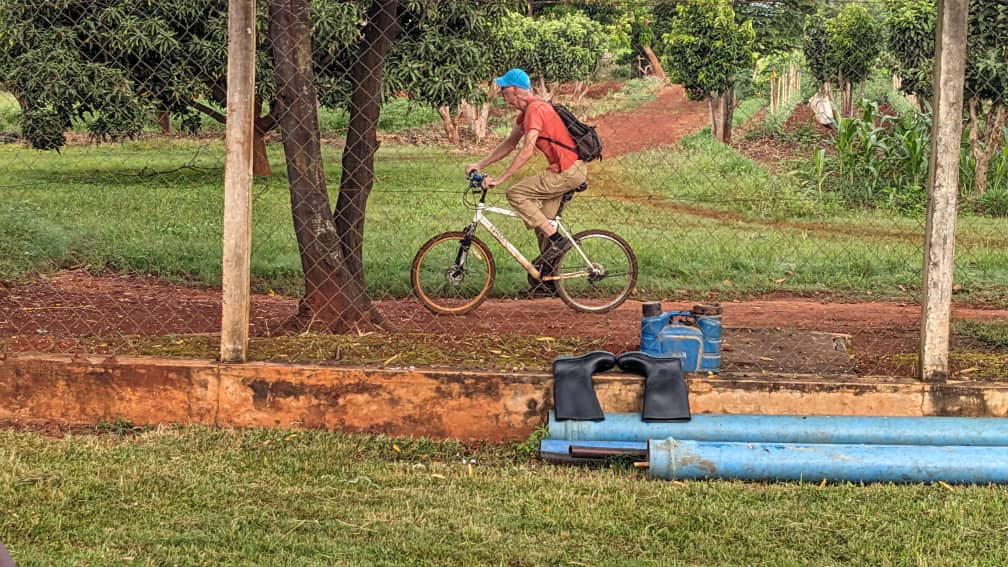
Tanzanians seem more addicted to their phones than Canadians. An in-person conversation gets interrupted at any second with a phone call. People walk around on busy streets looking at their phones. Motorcycle taxi drivers answer phones when driving with mother and child on the back of the bike. I ride my mountain bike through an Agriculture University on the way to the farm and everybody is hooked to their phone, many sitting glued to their screens.  

The phone is a tool that keeps families in-touch and drives them apart. A young Tanzania woman told me that the traditional family, with a father controlling what his daughters are allowed to do, has changed because of the smart phone. Traditional fathers would decide what their daughter could do and who she was to marry, but young women now see on their phones through social media apps that there is a wide world of possibility and now they won’t allow their fathers to limit their potential. Yet, there is a great divide between urban and rural norms. Many of the traditional ways are still very present in the regions.

After two decades of sustained growth, Tanzania reached an important milestone in July 2020, when it formally graduated from low-income to lower-middle-income country status. With increased opportunities and subsidized post-secondary education, extended families are dispersed through the entire country. Sons and daughters go to college or university – lives change and the influence of parents diminishes. Family, the core unit of cohesion and culture is quickly changing. Tribal affinities are still alive but it is evident that the attraction to everything available on the world wide web through the phone is disrupting societal bonds. 

Makyeo and Odillia

I work with a brother and sister here – Makyeo and Odillia. Their mother and father live a 10-hour bus ride away and their mother is very sick.  Similar to many of us in Canada, we want to care for our parents when they are old but few of us live in the same place we grew up. So, we put them in care homes which makes it easier for us but no parent wants to live in those places – my 92-year-old mother is an example. There are no care homes for the elderly here so Makyeo and Odillia rely on neighbors and relatives to care for their mother.  This is a relatively recent change; since time immemorial extended families lived in the same village or region for their whole lives. Video calls on the smart phone cannot replace the care and attention from being at home provides, but visual contact is better than nothing. 

Jackie with brother on left, mother on the right, niece below

Jackie’s mother is home now and healing from her surgery. Jackie is paying me back slowly over time – through M-Pesa. She calls her mother every day and pays as she goes.

Remember the Future

My time is running short here in Tanzania and I have already started some planning for the end of my placement which is September 30. 

I recently read A Brief History of Time and grasped about 3 % of the concepts about time and space. But one thing I picked up was in “the theory of relativity, there is no unique absolute time but instead, each individual has his own personal measure of time that depends on where he is and how he is moving.” Hawking implies in his twisted logic that in certain conditions, one would be able to remember the future. This idea contradicts traditional African cultures where there is no concept of the future. In the traditional African setting, time is a two-dimensional phenomenon, with a long past, a present and virtually no future. This is because the events in the future have not taken place. What does not exist, cannot be real. 

On a very practical level, I am confused regularly about the time of day. Telling time in Swahili is similar to the biblical system. Each new day begins at sunrise, that is 6 AM. There are 12 hours of daylight and 12 hours of darkness. Thus, there’s a difference of six hours between Swahili time in English time. 12 o’clock in English time will be 6 o’clock in Swahili time. This means that 7 AM global time is 1 AM in Tanzania. Some people use Swahili time and some use global time, so I always have to ask which clock we are using. I have been 6 hours late and 6 hours early on some occasions. 

Somewhere in-between these disparate concepts, I experience time as it is for me. What seemed like forever when I started – I now have just 3 ½ months. And there is a lot of this country I have yet to see. I will be traveling soon to the south near the Mozambique border for a project and then later to the east near the border of Malawi for travel and hope to go to the north to see Kilimanjaro and visit some archeological sites. 

Cassava

I was able to push through a major funding proposal that we hope will stimulate a value chain for cassava in the western region of the country. The concept is to introduce drying technology to dry fresh cassava. There is a huge demand for premium grade dried cassava in neighboring countries of Rwanda, Burundi, Congo and Uganda where they use for ugali – a daily staple in most meals as well as in bread and to make beer. Small holder farmers traditionally dry their cassava on the ground in the sun and significant rot and mould results meaning they get lower grade prices. We are introducing flash drying technology and new higher yielding varieties of cassava which together would increase farm revenues 10-fold. 

Am also following through with a project to improve economic opportunities for fishers. On Lake Victoria, in the north west part of Tanzania and important fishery takes place, Sixty percent of all sardines eaten in Tanzania come from Lake Victoria. Sardines are harvested in small boats and transported to Ghana island where they are piled on a sandy beach and left to dry in in the sun.  Up to 50% of total harvest is lost due to inappropriate drying conditions including contamination from contact on the sandy beach. We are proposing the use of large greenhouses with drying racks to eliminate the losses and increase the volume and quality of the end product. 

Virgillia and baby

I am happy to report that young Virgillia, mentioned in the last post, delivered a healthy baby girl in early June. She is healthy. Her mother is with her assisting. All good!

Abisola

I had been working with Abisola, another CUSO volunteer, for the last 8 months but Abi’s placement ended a week ago and she is now back in Brampton. Abi is an incredibly intelligent, sensitive and caring person whom I miss dearly. 

Direct Aid?

It is the rainy season and it is a bit cooler and obviously wetter. Some people are saying there is a lot more rain this year but I have no comparison. I like the cool weather and the clouds, have gotten used to the smell of mildew and the sound of a fan drying my clothes. 

Projects Update

I am in the process of submitting a lengthy proposal for funding to support a cassava drying project I’ve been pushing along since October 2023. Slow but sure.

I have proposed agroforestry concepts that compliment resilient agriculture practices. One strategy is to incorporate annual vegetables with bamboo. Annual crops are grown in an alley between rows of bamboo.  Alley cropping has been used in many tropical conditions and with the increasing severity of storms combined with prolonged heating periods, the soil binding characteristics of bamboo and the protection it provides from wind can save a crop. It also provides a secondary product – bamboo – which is useful to ensure income regardless of conditions. 

Another strategy which is more on the landscape level, is to intercrop annual vegetables with a variety of fruit bearing trees spaced widely for annual vegetables amongst the trees – called food forests. This has the similar effect as ally cropping except here the secondary products are fruit. In the region we are proposing this there are conflicts with a semi nomadic tribe – the Maasai, who graze their cattle throughout the landscape. So, this is a project which incorporates climate smart techniques and also addresses cultural and social challenges. The idea here is to establish dialogue between the different users and avoid surprises and conflicts; as well, to develop multiple crops with multiple markets to ensure economic resilience. 

Business Support

I have also been supporting several youths in their business development. James from a previous blog who is developing technology to support farm operations with automatic irrigation, weather data collection and forecasting. We have submitted several proposals looking for funding support. James has recently developed another device, a controller, which will assist him monitoring moisture and ensuring proper ignition.  

I have also been supporting a young fella who wants to develop a soya milk company in Tanzania. He has lots of energy and wants to get rich, so his motivation is clear. He grew up in poverty, and never wants to be there again. I am assisting him with a business plan and mentoring him as he works through the business concept. He learned recently that most of the soybeans in Tanzania come from Zambia. He did not know this until recently when he was in a different region of Tanzania. Soy beans here are primarily grown for feed and soybeans for milk are a different variety. So, there are multiple challenges with this idea, but he is persistent. 

My Swahili teacher wants to expand her business so I am helping her with her business and marketing plan. I get free Swahili lessons over skype and she gets what she needs from me. It’s a good exchange and we are becoming friends. Rafiki yangu (my friend). 

SUGECO projects

I have also been supporting projects that SUGECO has recently been awarded. There are two projects which are almost exactly the same. Both projects involve developing farms to support youth and agricultural entrepreneurship. These farms involve developing water sources and infrastructure to support farm operations.  The intention is to engage over 400 young people and provide them with a half-acre of land to grow crops where SUGECO has developed contracts with buyers. This sounds good, but these are convoluted concepts with unreasonable deliverables, and the organization does not have the capacity to implement the project. There’s a big disconnect between the people who have the ideas, submit the proposals and people who are on the ground implementing the ideas. There is a schism developing between staff and management. Somewhere in there I am involved, but mostly as a consultant providing pragmatic suggestions and emotional support. 

There’s a lot to say about “development.” Many people have asked me if I feel I am making an impact. I don’t think much of anything I have contributed would be missed. But I am helping people in direct ways. The business support is direct and the young people are grateful.  More on “development” in a future blog. 

Direct Aid

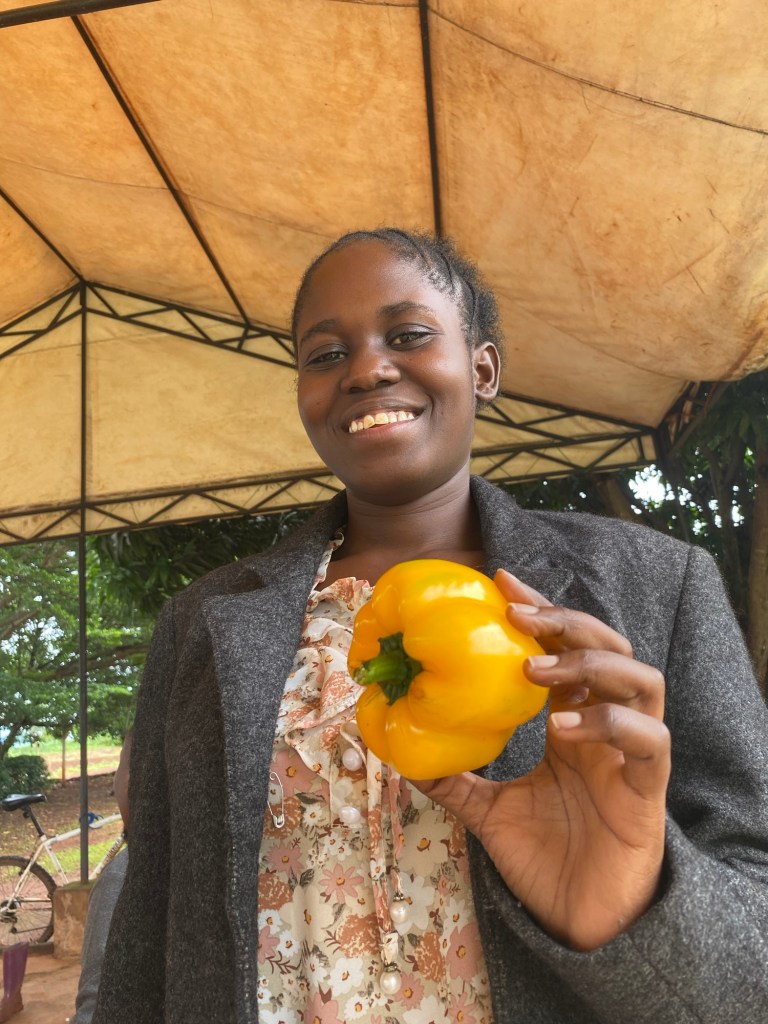
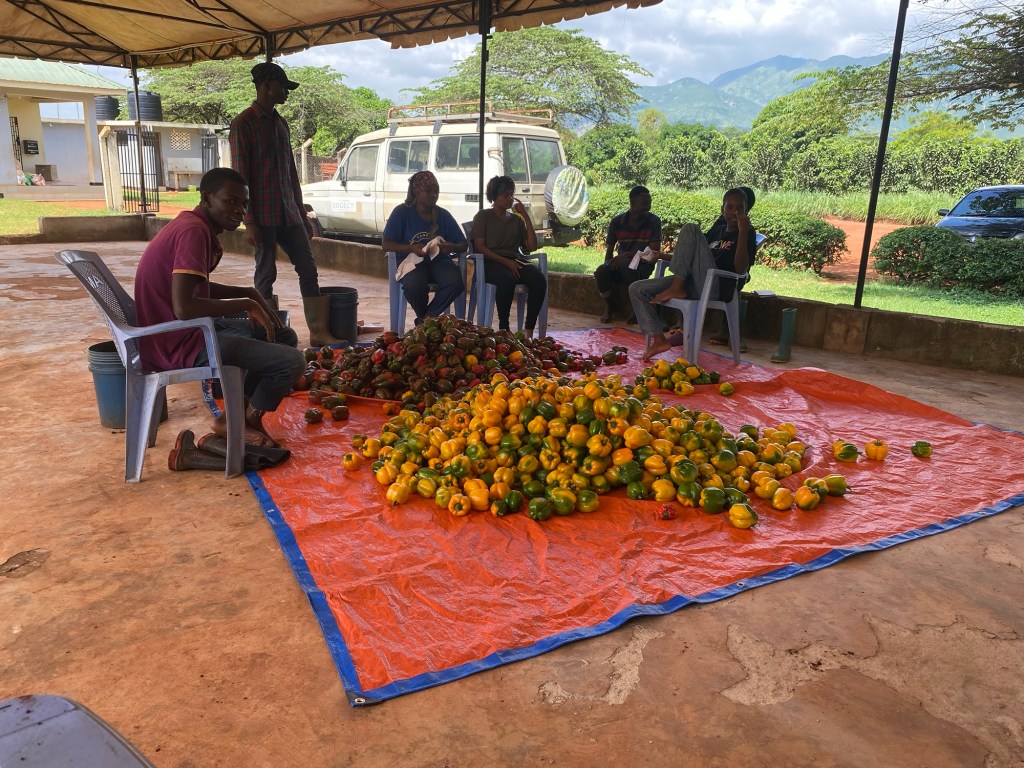
There is a delightful 20-year-old woman farmer here, Virgillia, who is 7 3/4 months pregnant. She has a ½ acre of habanero peppers that are just starting to ripen and soon she will not be able to harvest. The father is farm staff here and he is denying that the baby is his. Her parents have disowned her because she is pregnant and is not married. She has been coming to me for emotional support and because she needs things for the baby. I connected her with my Tanzanian friend Jackie who has two children. I am buying things that Virgilia will need and Jackie is helping Virgilia understand what is ahead of her. This is one way I know I am making an impact. 

Virgilia at her pepper plot

The distressing thing is how normal it is for a man in Tanzania to be the father, everybody knows it, and he can go along and deny it. There is no recourse for the woman. Traditionally babies are the responsibility of women and many men have babies with women outside of their marriage. It is normal. 

This is a hangover from tibial culture before colonial contact. Men would have 3 to 5 wives living in a compound. More wives mean higher status. These days, Christian men feel free to live this way secretly. It’s none of the wife’s business what the man does but if a wife has an affair, the marriage would end immediately, or worse … 

Today it is sunny. 

Previous Posts

Oct. 2023 https://twoacres.blog/2023/11/02/a-month-in-morogoro-tanzania/
Nov. 2023 https://twoacres.blog/2023/11/24/learning-to-wait/

Dec. 2023 https://twoacres.blog/2023/12/29/genetic-brothers-and-sisters/

Jan. 2024 https://twoacres.blog/2024/01/22/being-ki-rafiki-friendly-and-other-stuff/

Feb 2024  https://twoacres.blog/2024/02/26/ah-to-be-young/

April  2024  https://twoacres.blog/2024/04/14/meandering-mzungu/

Meandering Mzungu

On Easter long weekend I had some time take a trip and see some sites. Many people were traveling for the holiday. Approximately 60% of Tanzanians are Christians, and 35% Muslim. This year Easter was in the middle of Ramadan and this only happens every 30 years. So, folks were on the move. 

I made the mistake of waiting till the morning of Good Friday to buy a bus ticket. So, I sat on a concrete bench, waiting for my bus arrive. The bus depot was full of families and everybody was waiting.  Tanzanians have a nonchalant look about them when waiting. I started to wonder if they were frustrated and anxious like me or if it even feels like waiting to them. 

Using the computer in my hand, I learn there is a different concept of time and a deeper meaning of the proverb – “the white man has the watch and Africa has the time.”  

Some anthropologists who study these things claim that traditional African cultures did not have a concept of the future. In traditional cultures, time is composed of a series of events, and since future events have not yet occurred it follows that the future is nonexistent and meaningless. They claim that the western linear concept of time as past present and future is foreign to African thought. 

Events have occurred – past – and are in the process of being experienced – present – or may be certain to occur in the rhythm of nature. But these rhythms are not considered a future, they are inevitable like – the rains will come. 

 In Swahili, present is Sasa and the past is Zamani. No word for future exists. I pondered these things as I was waiting for my bus. Which did come in the future – five hours later. 

Grave for Child Saint – Kaole Ruins

There are layers of the past in Tanzania, some of which I wanted to investigate on my weekend excursion. 

Slave Trade Route. Ujii-Bagamoyo-Zanzibar

Deep Deep Past
In fourth grade I learned of Louis Leaky and Olduvai Gorge where some early findings of our deep past were unearthed. At Olduvai Gorge, near Mount Kilimanjaro in northern Tanzania, Mary Leakey found a 2-million-year-old skull of the “ape like” Australopithecus. And Mary and Louis’ son Jonathan found the mandible that proved to be from Homo habilis, a link to Homo sapien. I’m sure they had timeless conversations around the Leakey family dinner table. Olduviai Gorge is a likely destination for me, but for a 14-hour bus ride I need more time. 

My objective for the weekend was a little closer to home, in distance – a place called Bagamoyo, which was the centre for a couple of layers of human history. 

Arab Colonists

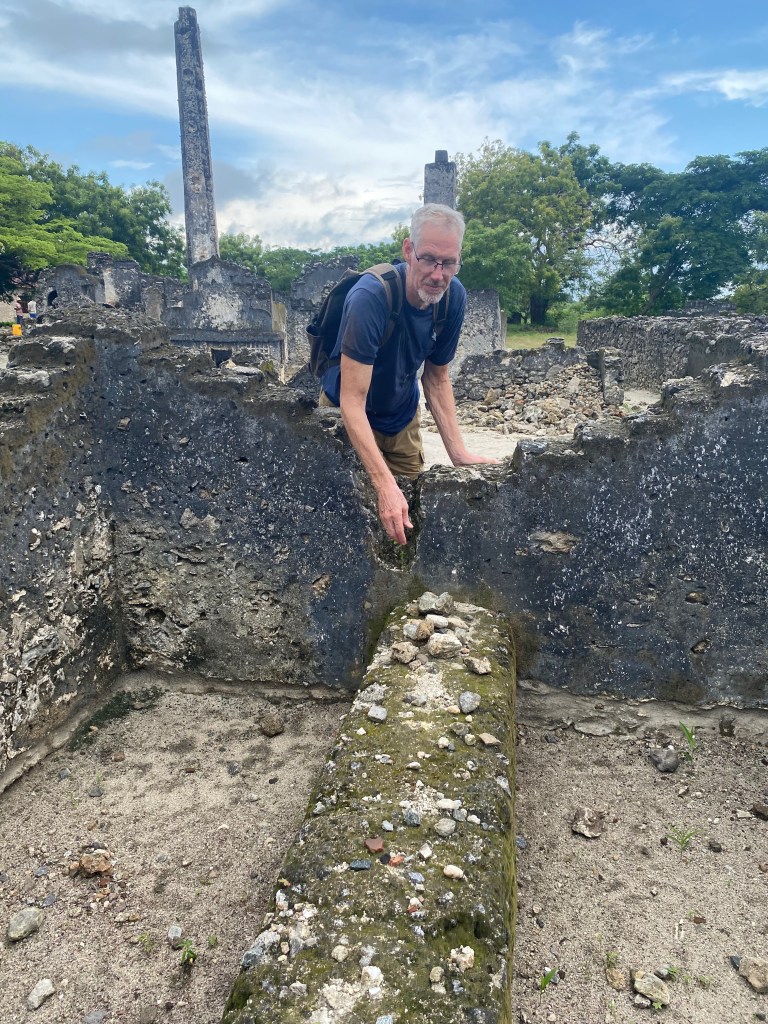
In the 8th century Muslim traders from Arabia and Egypt began to settle and trade in centers along the Swahili coast. Very close to Bagamoyo is an ancient site of one of the first permanent Arab settlements on the East African Coast – the Kaole Ruins. This includes the remains of a Mosque built in the 13th century and graves of prominent community members – the oldest such site in East Africa. 

The site is a 15-minute ride on the back of a motorbike dodging potholes, chickens and children. The ruins are not spectacular although the building material – coral has a surprising stability. I had an enjoyable time with the guide – washing my feet and hands in holy water and praying to a couple of Profits – dropping 1,000 Shillings at each site, where the guide promptly took my offerings to the office – that’s why they call them profits.  

The Slave Trade

Slaves from the interior of Africa were gathered at Bagamoyo port by native, Arab, and Portuguese traders for shipment on to Zanzibar, which, in the 1700s, began providing slave labor for local plantations, European colonies in Africa, and a small number of American plantations.

Bagamoyo for this slave route serves as the terminal which starts from Ujiji (where I was in December).  From Bagamoyo, slaves were shipped to the island of Zanzibar (where I was in Oct 2023) and at the slave market men and women were sold and taken to destinations. One can see Zanzibar across the ocean from Bagamoyo. The port where slaves were put on dhows and sailed to Zanzibar is where the current Bagamoyo fish market is. 

Unintentionally I have visited the axis points of one of the slave routes in Tanzania. 

European Colonists

In the nineteenth-century the Germans arrived in Bagamoyo and left their imprint. Ostensibly they colonized East Africa in order to stop the slave trade but ended up profiting off it like all other colonists. They did a lot of building in Tanzania in a short time (1880 – 1918), including many buildings in Bagamoyo and they built a railway from the coast to the eastern side of Tanzania – Lake Tanganyika. The Brits took over after the First World War. Interestingly enough the Germans, like the Kaole Arabs, used coral as a building material. One can only guess how much ocean habitat was destroyed. 

In 1822, the British signed the first of a series of treaties with Sultan Said of Zanzibar to curb this trade. Under strong British pressure, the slave trade was officially abolished in 1876, but slavery itself remained legal in Zanzibar until 1897. Slavery was only abolished in Tanganyika in 1922, so there are many monuments and memories remaining in Bagamoyo concerning the slave trade. Tanganyika and Zanzibar were separate countries but united on 26th April 1964, forming the United Republic of Tanzania. 

Being White in Black Culture

Waves of dominant cultures have levelled abuses and injustices on these peoples. Yet Tanzanians are a proud peaceful people, focused on developing their country and raising the standard of living for all. Fortunately, the country is devoid of tribalism and the influence of extremist factions. 

There is nothing overt, or blatantly racist I experience, yet my skin colour and my height draw a lot of attention, and not all of it is positive. Indirectly, I encounter a lot nonverbal or obvious resentment. I am a mzungu. There are different connotations of this. How I hear being referred to as mzungu and how I interpret is different in different situations. At the basic level, a mzungu is a white person. But there is a lot of baggage from centuries of abuse at the hands of white people and white people are most often associated with wealth and power. There is also strange kind of respect, admiration and status associated with mzungus. Example – leaving Bagamoyo I was shuffled onto one of two busses going the same place because there is status having a mzungu riding on your bus. 

Mostly I just accept the commonness of being called mzungu but often times I hear some of the baggage behind the “cat call.” It usually happens as I walk past a group of men who look at me with resentful eyes and then I hear discussion as I walk past as they refer to the mzungu and laugh. 

“Mzungu” is simply a factual acknowledgement that here is a “white person” for most, but for some it is everything a white person represents for the person saying it. And what is represented are the layers of history. 

Previous Posts

Oct. 2023 https://twoacres.blog/2023/11/02/a-month-in-morogoro-tanzania/

Nov. 2023 https://twoacres.blog/2023/11/24/learning-to-wait/

Dec. 2023 https://twoacres.blog/2023/12/29/genetic-brothers-and-sisters/

Jan. 2024 https://twoacres.blog/2024/01/22/being-ki-rafiki-friendly-and-other-stuff/

Feb 2024  https://twoacres.blog/2024/02/26/ah-to-be-young/

Ah to be Young

In Tanzania – a population of just over 63 million people – more than 50% are under the age of 18, and 63% are under 30. The median age is 17. 69% are considered youth between the ages of 15 and 35. Tanzania has almost exactly the same land mass as British Columbia. Population BC – 5.5 million.  In Canada, 19% of the population is between 15 and 30.

Tanzania is struggling with this bulge in its demographic. Youth are unemployed, or under employed or doing work as a last resort. Tanzanians by nature are entrepreneurial it seems to me. Every youth out of grade school is hustling to make a Shilling. They are out on the corners selling whatever they can get their hands on. Street vendors are out early in the morning as the sun is rising and finish as the sun is setting,  And most nights the sidewalks are filled with vendors selling fruits, veggies, cooked food, household items and clothes. Many of the young men end up driving a tuk-tuk or a Boda-Boda (motorcycle) and drive all day ferrying people around.  

Young Entrepreneurs  

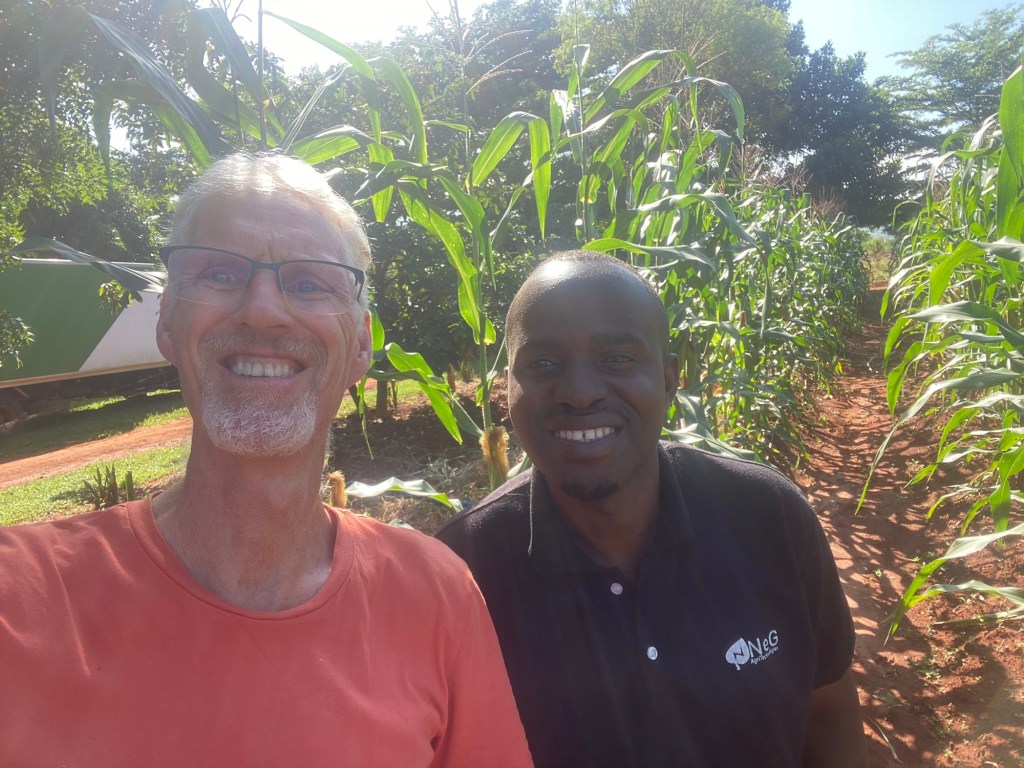
James of NeG and James of Creston

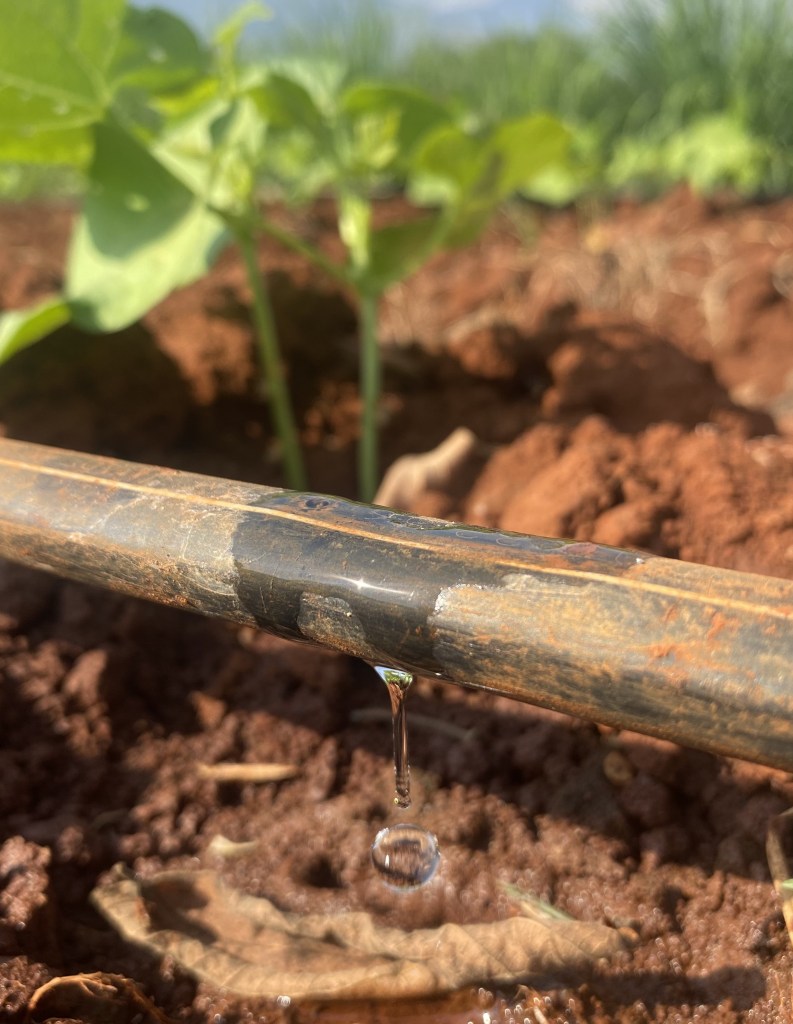
James when in University formed a collective of progressive students and initiated a technology community focused on agriculture, organizing weekly discussions to explore ways of transitioning traditional farming practices into more advanced systems akin to those seen in developed countries. He spent a year in Israel on an agricultural internship where was exposed to irrigation systems and agricultural data collection systems. He returned to Tanzania and started his own company (NeG Agrotechnologies) and smartly involved some technology developers and researchers from the agriculture university here in Morogoro. In just two years he has developed an entire weather station that collects all weather data and soil moisture information, all uploaded to a cloud that can be read on an app on his phone. He also developed a controller to operate automatic drip irrigation systems which is controlled from a smart phone.  All of this technology is readily  available on the open market but he wants to develop a Tanzanian version that can be built and distributed in Tanzania and all across sub-saharan Africa and make it affordable for small holder farmers across the continent. I have helped him secure some land here at SUGECO where I work, to develop the technology and test it. SUGECO is a hub where lots of new farmers, potential investors and funders come, and he can show off his smart farm technology. I’m also helping him to apply to an opportunity called Builders of Africa’s Future, where if he is chosen he will get business skill training, introductions to Silicon Valley tech investors, mentoring and networking opportunities. 

Mkushi

Another young guy, Mkushi, who is an engineer and just finished his Masters in project management already has a business building agricultural structures and systems but he has an idea that could transform the fresh water fishing industry and I’m helping him develop the idea to attract investment. Lake Victoria straddles Tanzania, Uganda and Kenya contains a big fresh water sardine fishery. It is Africa’s largest lake by area, the world’s largest tropical lake, and the world’s second-largest fresh water lake by surface area after Lake Superior.  The fishers put their nets out at night from small boats and they take their catch to an island on the lake and dump the catch on the beach. They lay it out there to dry, the product – dried sardines – are sold all over Africa. About half of the catch rots on the beach from contamination or it dries too much in the hot sun or they can’t fish at all in the rainy season because the fish won’t dry. So he has developed a drying system involving greenhouses, drying racks and solar powered heaters. Potentially this could reduce the post catch losses and put more money in the hands of the fishers. I have developed a proposal for him that he has used to attract investment and I am investigating funding opportunities for him. 

Some Initiatives

Access to land for young aspiring farmers is a major barrier for youth. There are two major barriers. For those who want to take over the family farm there is a delayed transfer of land ownership to youth due to increased life expectancy of parents (In 1980 life expectancy was 51, in 2023 – 66).  For those who aspire to farm and are not from a family farm, lack of capital is a principal obstacle because youth do not have the required collateral to get loan from financial institutions. This is a familiar scenario in Canada. I am working with folks here to develop a land bank with SUGECO where we will facilitate land owners depositing available land that can be loaned/rented out  to young farmers and be utilized according to an agreed business model. This builds on land matching programs that operate in BC and all through the States and Europe. Am at early stages on this initiative. 

I have also been developing a business development program for aspiring agri-business youth. Many young people have good ideas and want to start a business but really don’t know what to do and how to start. I have been developing a 6 month program where they will learn some basics like market research, writing a business plan, learning capital and financial management skills, branding and marketing techniques, product development and more. With this I am trying to get the Morogoro Chamber of Commerce to participate and have business owners participate with instruction and more importantly – mentor the students. Once again, in early stages. You are probably wondering how does James know anything about business, he has never owned a business. If you are one step ahead of the guy behind you, you can lead him. Plus, I am building this idea through talking to new business owners, bankers and academics who all support the initiative and am relying on their knowledge. I have time. I have instant street credibility here because I am white – its a sad fact but it is a fact.

Other News

The cassava project mentioned in past posts is in delay mode. Nothing more to say at this point. I did all the work and I am waiting for information from managers. Learning to Wait

CUSO is going through a major shuffle. 15% of their budget was cut – the major source of their funding is Global Affairs Canada. Liberals are presenting a balanced budget for 2024 – in preparation for the next election – hence the cuts. CUSO decided last fall that then would have to consolidate operations through all of Africa. The country program manager in Tanzania lost his job but 2 of the other staff in the Tanzania office will still be working. It’s causing a big ripple in the programs and support for volunteers.  The guy who lost his job is fine with it, he said he can now focus on what he really wants to do – avocado farm.

Being Friendly and other stuff …

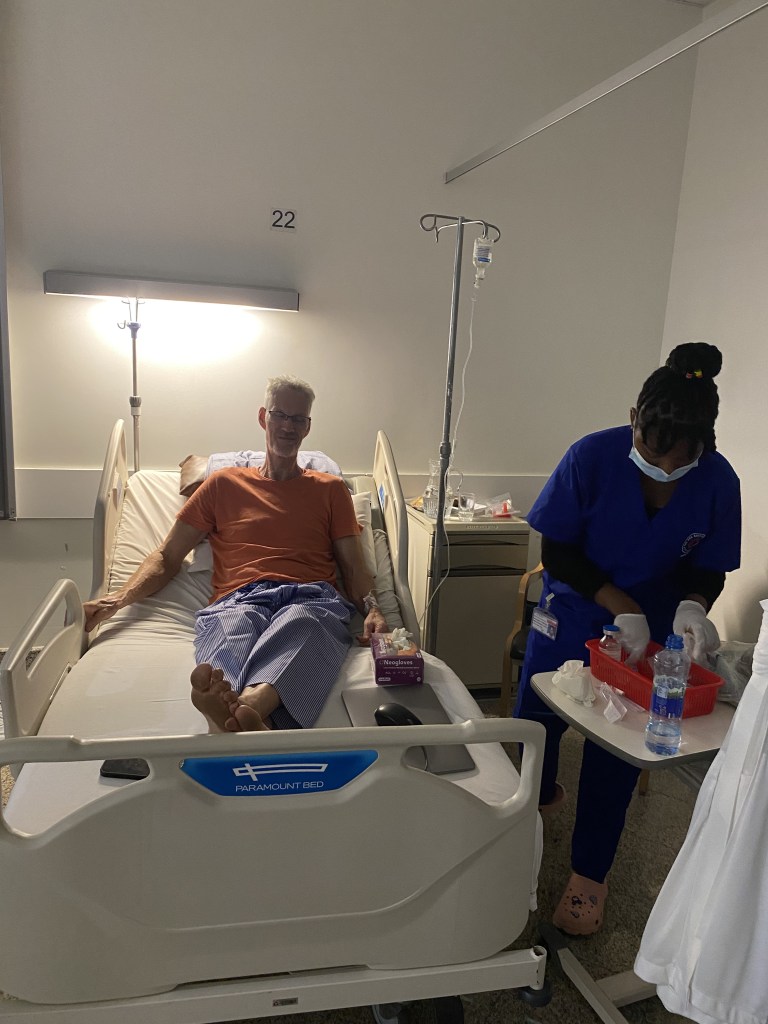
I am well. I was sick for over a month and was in the hospital but am well now. It took up a month of my life, my thoughts and my energy and I’m tired of thinking about it. Many thanks to those who knew and reached out. 

I am focusing on happy things and encouraging encounters now. There is so much of this. 

Why don’t you say hello?

When we were driving around Ruaha National Park in October looking for lions and elephants, we would encounter other safari vehicles on the narrow dirt tracks punched through the Savana. Ben our driver, would pull up to their vehicle and the Tanzanians would have a 5-to-10-minute conversation in Swahili with lots of laughing and gesticulations. The white folks in both vehicles most times didn’t even say hello, maybe provided an uninterested nod, but that was it. Ben asked me, “why don’t you say hello. If I was in Canada and I saw a black man and I could talk to him in my language we would be instant brothers, I’d want to know everything about him … .” 

This happens when I am in Morogoro too. I see white people, which is seldom, and our encounters are rarely vocal, no more than a nod of recognition and maybe hello. Another mzungu …

Friendliness is a nationwide phenomenon. When Tanzania gained independence from Britain (1961), the founder Julias Nyerere encouraged all tribes to think of themselves as Tanzanians first and their tribe affiliaton second. This had profound implications. With the exception of Kenya, the many conflicts of boarding countries to Tanzania are the result of tribal fighting, religious differences and corrupt iron fisted dictatorships. Note – one million Tutsis murdered in 100 days during Rwandan genocide. Since 1998 over 5 million have died in the Democratic Republic of the Congo (DRC) due to territorial and tribal disputes. Tanzania is a bastion of stability surrounded by unstable nations. Can a leader influence friendliness? It’s very evident a leader can instill anger – i.e. – The Donald. 

Does this have anything to do with an economy? Tanzania just recently (2020) rose from being designated a poor income economy to lower middle-income economy and is poised to become a middle-income country in the next 5 to 10 years.  Countries with less than $1,035 Gross National Income per capita (the dollar value of a country’s final income in a year divided by its population) are classified as low-income countries, those with between $1,036 and $4,085 are lower middle-income countries. Will friendliness ride along with an improved economy? 

My theory, there is no relation between friendliness and personal income. Friendliness is a cultural quality. Perhaps there should be a GFI – Gross Friendliness Index. Tanzania would rate high on this. Many studies show that being friendly to strangers creates a feeling of wholeness and well-being and … happiness. Tanzanians are very friendly to me.  Hmm, I could learn from this. Personal commitment – be friendly to one stranger every day. 

One can fall into a google abyss searching for definitions and lists rating the friendliest and happiest countries in the world – I just pulled out of this google crevasse, don’t go there. But I learned that in 2011, the UN General Assembly adopted a resolution “Happiness: Towards a Holistic Definition of Development,” but looking at the list of the happiest countries I am skeptical of the criteria and metrics used. All of the countries in the top ten for 2023 are “developed” countries. 

Food Beautiful Food

I rarely see my Tanzania colleagues at work eat. The farm is on university land and we are close to student residences where there is a cafeteria a 15-minute walk away, few go there. I see the field staff hanging out by a fire mid-day where they drink tea and cook ugali – a staple food consisting of corn meal boiled in water or milk. I bring nuts and a sandwich to the office and I have learned to bring a lot more than I can eat because if you have food you must share. So, half of what I bring goes to several of the people who drop by my desk to say hello. I know I have created expeditions, but food is to share. The five or six cashews I give them may be the only food they eat during the day – its’ hard to know. Nobody is starving, but I can’t figure out when they eat. 

When I was driving with Ben recently, he stopped to buy some mangoes on the side of the highway. He bought four dozen – I commented, “wow, you must love mangoes,” but found out he must distribute most of them to his brothers and sisters’ families – it’s expected. Ben comes from a Muslim family of 30 brothers and sisters – his father had four wives and four families. They have a good time when they get together, and they eat a lot of mangoes. 

On the Work Front 

I wasn’t able to work for over a month from being sick in December and early January. But I am continuing to develop a project involving cassava and finding many challenges with getting good information. My job is to take the idea and work out all of the elements, processes and costs. And every few days a new idea comes to me from managers and I try to incorporate it into a proposal.  It’s a really good project with massive potential and if it ever gets off the ground it will change the lives of farmers, provide employment and generate entrepreneurial opportunities for youth and or women to develop agriculture businesses. I’m hopeful. 

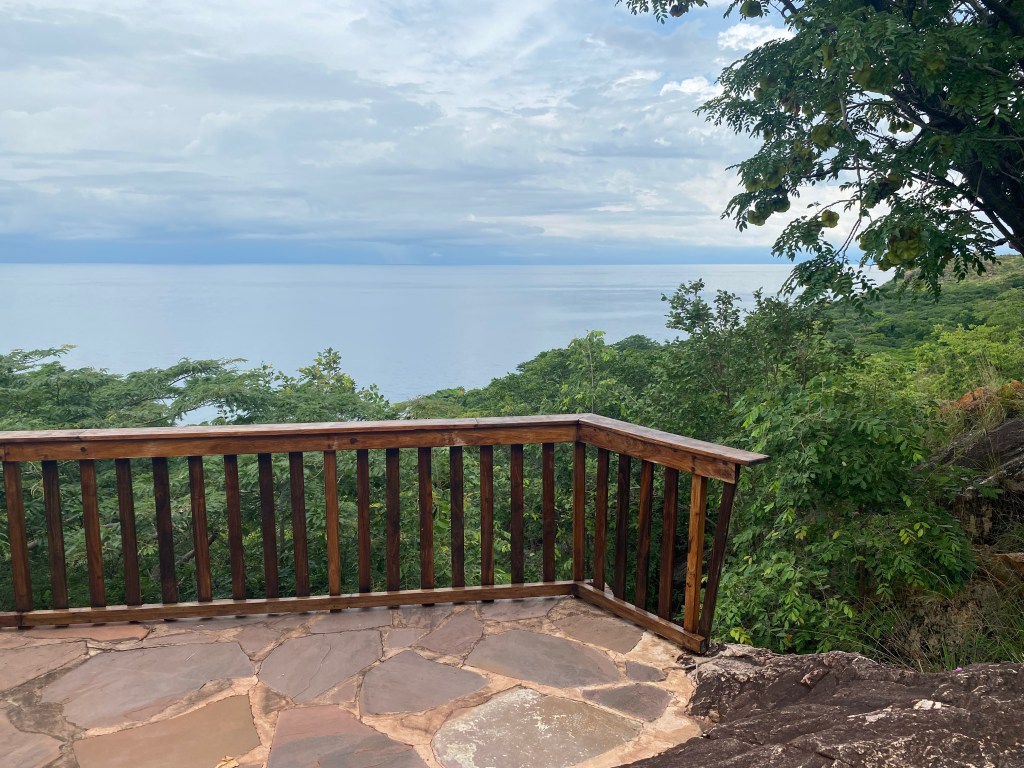
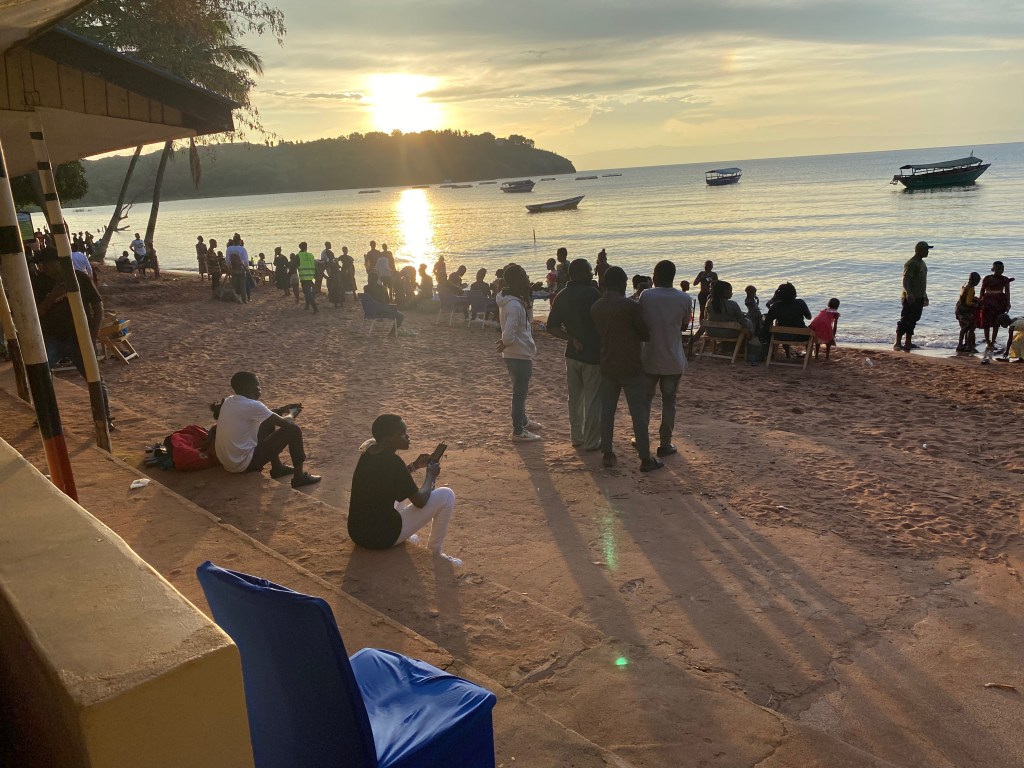
The designated location for this project is in the western region of Tanzania – Kigoma. I travelled to Kigoma in December and was there for 10 days to see bit of the country. Much of my time was beside Lake Tanganyika – the longest freshwater lake in the world (660 km) and the second deepest (1,436 meters). DRC, Burundi and Zambia boarder Tanzania on the lake. I went there because I like lakes and I wanted to see Chimpanzees. Jane Goodall did her work where I visited, it’s now a National Park. Gombe Stream . Swimming in the lake was fabulous. Some English folks I met in the town went to a different park along the lake – more remote – and they were not allowed to swim because hippos and crocodiles hang out on that beach.  Christmas in the town of Kigoma was very nice beside the lake with beer and mishkaki (kabobs) and where many families go to celebrate.  The 19-hour bus trip back to Morogoro was not beneficial to my health. Note to self – travel when healthy.

Videos and Pictures below.

When it rains, it rains.

Genetic Brothers and Sisters

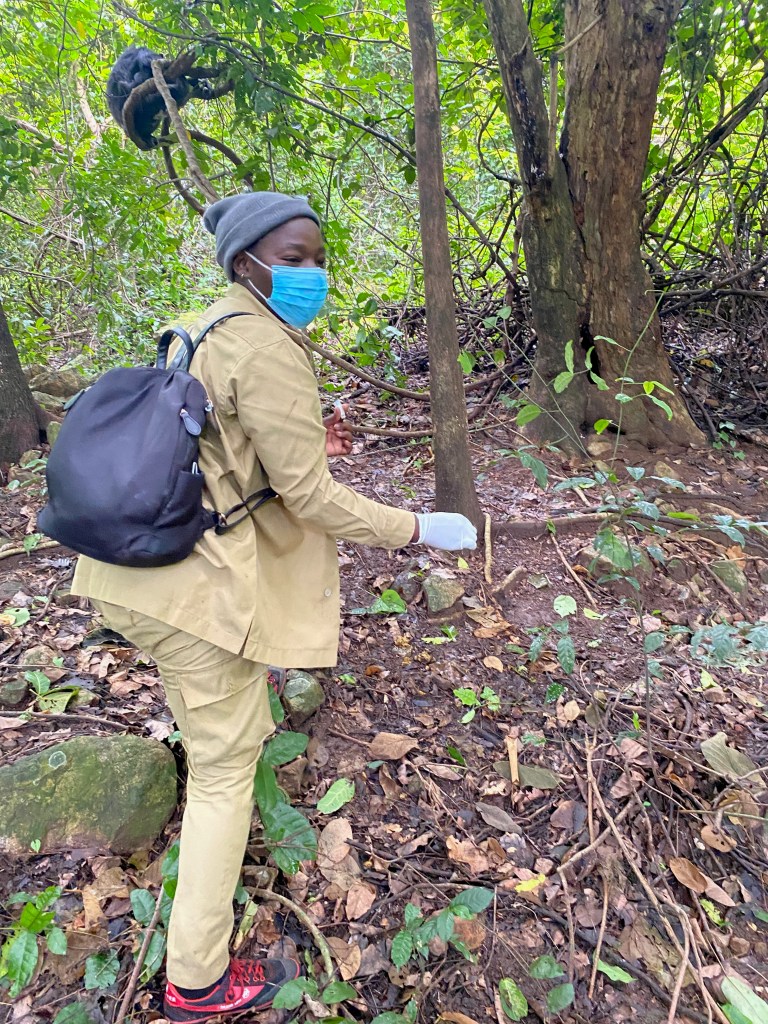
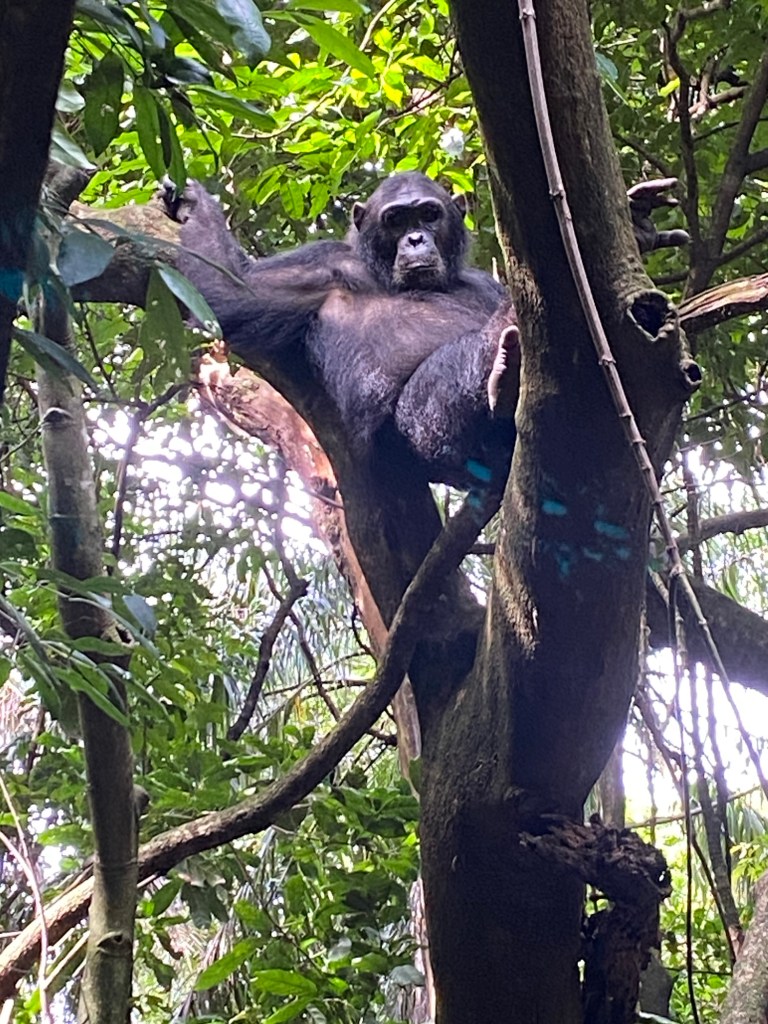
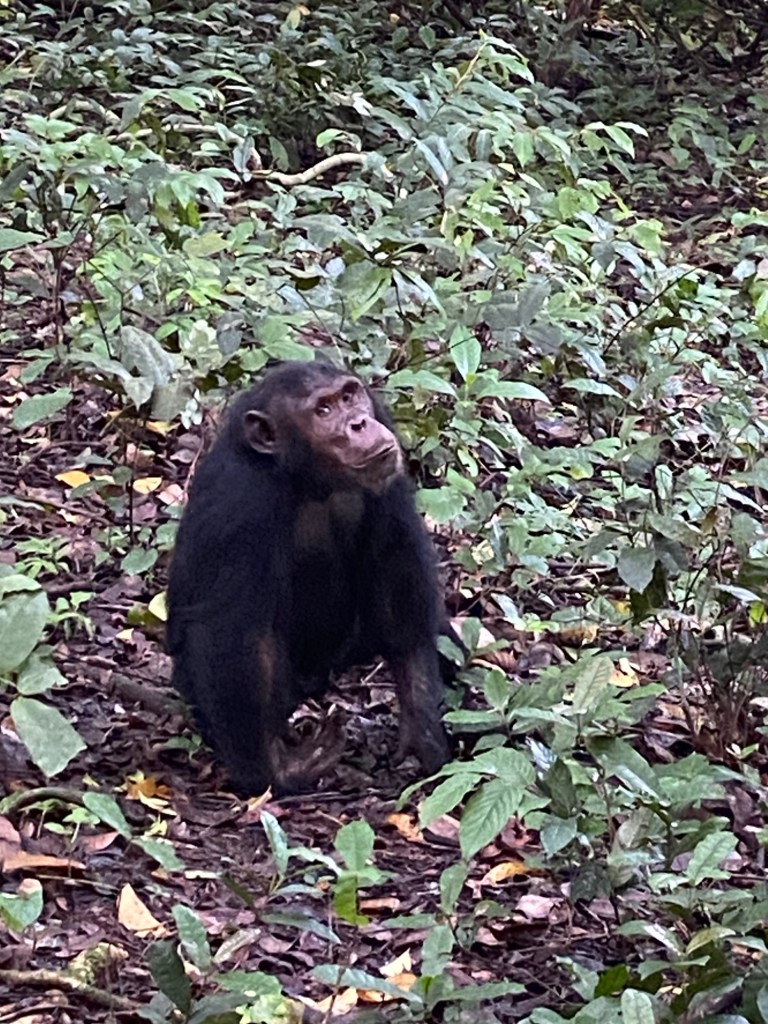
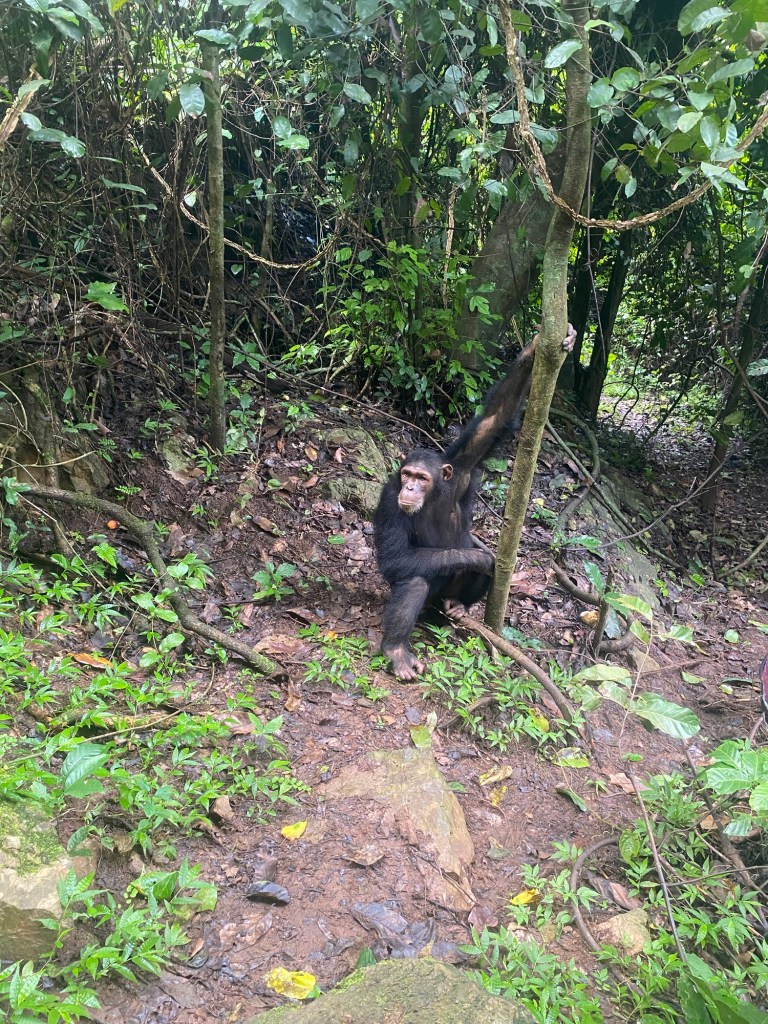
Was fortunate enough to spend some time amongst 2 different Chimpanzee troops. Some special moments with these beautiful beings.

We had to wear masks to stop the death of Chimps who get the same viruses that humans get. We share 98% of our genes.

Blog at WordPress.com.

Up ↑